|
| Herslev church, Vejle amt (Google earth) |
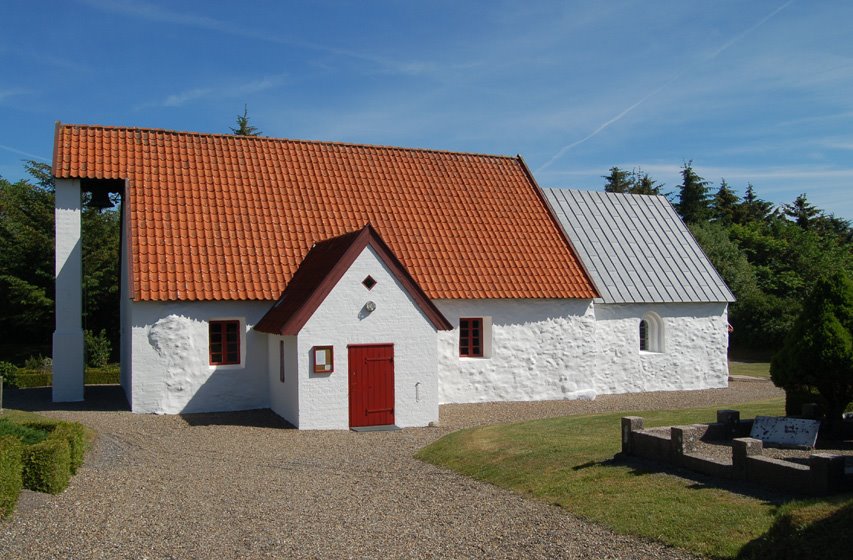
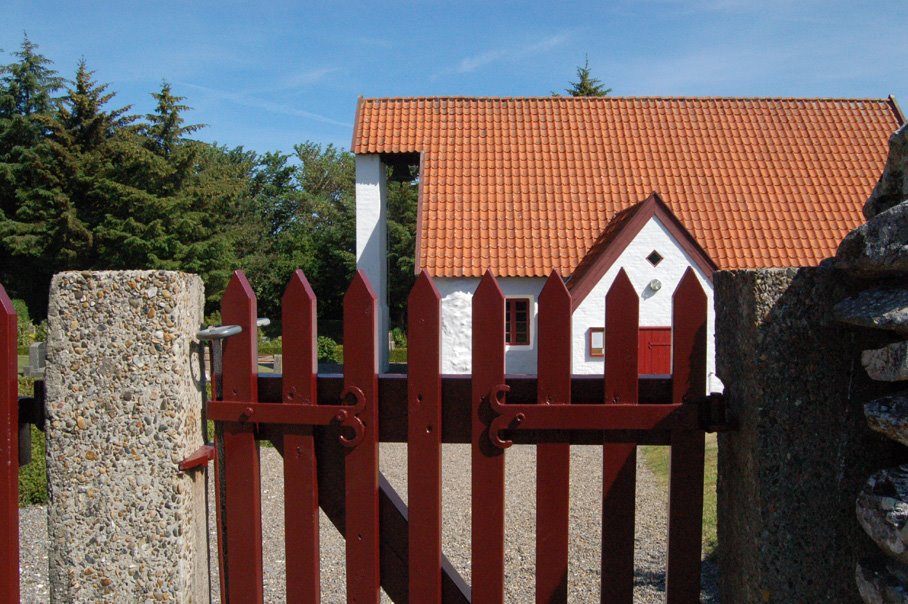
Herslev church lies by a large prehistoric hill. The long church with a leaden roof has a choir and nave with a porch to the southside. The Romanesque cernel is the western part of the choir and the added eastern part of the nave built in granite ashlars upon a profiled plinth; they are both extended, the nave probably twice to the west and the choir in the late Middle Ages to the east. In the 1800s the walls were partly covered with cement plaster, which did erade many traces, but a couple of Romanesque windows are seen, one in the south wall of the choir and one in the extension of the nave at the southside. At the same time as the eastern extension the choir got a Gothic rib vault. The porch, which originally is late medieval and in the 1700s was rebuilt with swayed gable steps, was completely re-bricked during the restore of the church in 1881, above the door is inserted a granite head from the Romanesque church. The western gable of the nave was re-bricked in 1787, which year and Chr. VII's (?) crowned monogram were seen here earlier, it was re-bricked again in 1881, a new main entrance and above the gable-top a bell step. Acc. to Pont. Atlas the bell also in the 1700s hang upon the western gable, but in earlier times there was supposedly a bell frame upon the northwestern corner of the church yard.
 |
| Herslev church with poplars (bell frame on hill in background) (Google earth) |
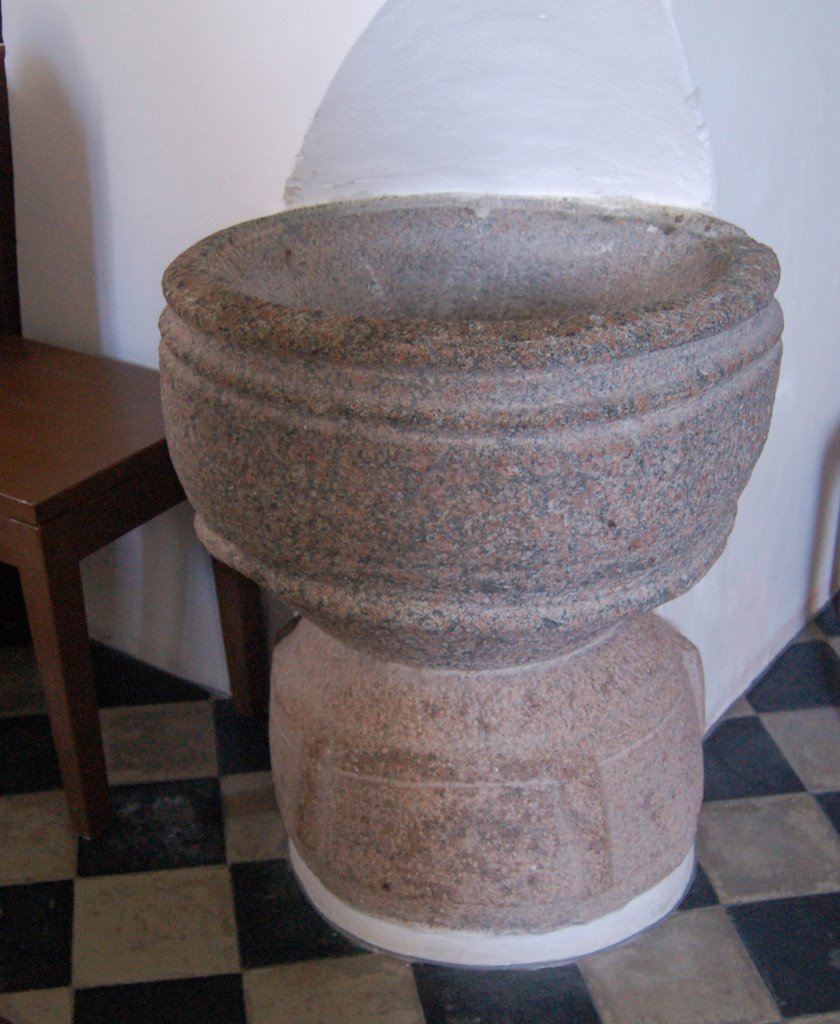
The inside of the church has a beamed ceiling in the nave, the choir arch is kept with profiled kragsten (corbels) and foot pieces. Upon a newly bricked communion table stands a late Gothic triptychon, carved by the local carver ( called the Herslev-master) with a biblical image. In the sidewings are 12 lesser apostle figures; upon the high predella was in 1736 painted biblical images, and at the same time the altarpiece got a top piece with Chr. VII's (?) crowned monogram, restored in 1919. Chalice from 1697. Wafer hide 1732. Upon the communion table stand two high, driven brass candelabres with winding shafts from the late 1600s. A Romanesque granite font upon a foot like a reversed cubic chapiters and with arcade motifs upon the basin. A south German baptismal dish from ab. 1575. A newer font-cover of pewter, given in 1911. The pulpit with a painted year 1601 has got fluted Tuscany columns as a frame around round arched fields with later painted Evangelists. Upon the north wall of the nave hangs a large choir arch crucifix, probably from the same carver's workshop as the altarpiece. Upon the north wall of the nave hangs a copy of Leonardo da Vinci's painting The Last Supper, painted 1878 by M.P.Morvig and given to the church in 1880. A Romanesque gravestone in two pieces is by the door of the porch. At the door of the western gable lies a big gravestone from the 1600s with a worn inscription. Series pastorum upon the north wall.
 |
| Herslev vicarage, Google earth |
Follerupgård
A farm in Follerup belonged in 1562 to Lave Brockenhuus (died childles in 1569); his brother's son, Ejler Brockenhuus exchanged in 1579 his part of 5 farms in Follerup to the Crown. The Crown sold in 1664 the village to colonel Lave Rodsteen (+ 1673), who later wrote himself of F., but in 1669 it came back to the Crown, which laid it out for military purpose ( ryttergods). When this was sold in 1765, one of the farms came to Niels Pedersen Smidt of Rønshave, who in 1776 sold it to Nik. Paulsen (+ 1808), who extended the farm and thereby founded Follerupgård. It came to H.N.Sønnichsen, later of Slumstrup, who in 1810 sold it to lieutenant Chr. N. Rønnenkamp, who in 1835 transferred it to his son-in-law, Ludvig Ferdinand Holst. He sold it in 1859 to Chr. Bay (+ 1904),who extended it. His widow Mary Quistgaard sold it in 1911 to agriculture-candidate N. K. Nielsen, who in 1929 sold it to C. Buhl; in 1964 it was owned by his son H.C. Buhl.
Herslevgård belonged in1492 to Mourids Stygge, whose son's son by the same name in 1579 exchanged it to the Crown. The present H. was from 1851 owned by Peder Nielsen, 1887 his son Niels Pedersen, in 1911 by the son-in-law S.N. Sørensen, in 1964 by fru E.M.Hansen.
In 1479 is mentioned the deceased Christiern Andersen (Sandberg) in Højrup, his great-grandchildren Peder Eggertsen (Sandberg) and Mikkel Nielsen (Sandberg) and son-in-law Gilbert Jung exchanged in 1579 and 1581 the farm to the Crown.
Gravengård was sold by Inger Hermansdatter Pennov to canon Jon Pedersen, who in 1442 willed it to Ribe chapter.
The common tinghus (judicial) for Elbo, Holman and Brusk herred (districts) was in 1687-1912 placed in Herslev village. Follerup village and Follerup mill were earlier considered to be under Holman herred.
In the parish was probably once a village Høvedgård (1442 Høwetgardh), in which the above mentioned Gravengård was placed.
During ploughing a field at Bolskov were in 1879 found 85 dalere (coins), mainly from Germany and Netherland, the youngest coin from 1655.
Listed prehistorics: a large hill at the church yard and a lesser hill Troldhøj in Kobbelskov.
Demolished or destroyed: 32 hills.
In a moor at Herslev were found two twisted bronze-necklaces. Several Iron Age settlements, especially along the southwest border of the parish.
Names from the Middle Ages: Herslev (1231 Hærslef); Tolstrup (1484 Tolstrup); Højrup (1416 Bistop Hødrop, 1479 Høruph); Follerup (1503 Falldrop, 1524 Ffollerop).
Source: Trap Danmark, Vejle amt, 1964.
Photo: from Google earth.