Showing posts with label ruin. Show all posts

Monday, April 01, 2013

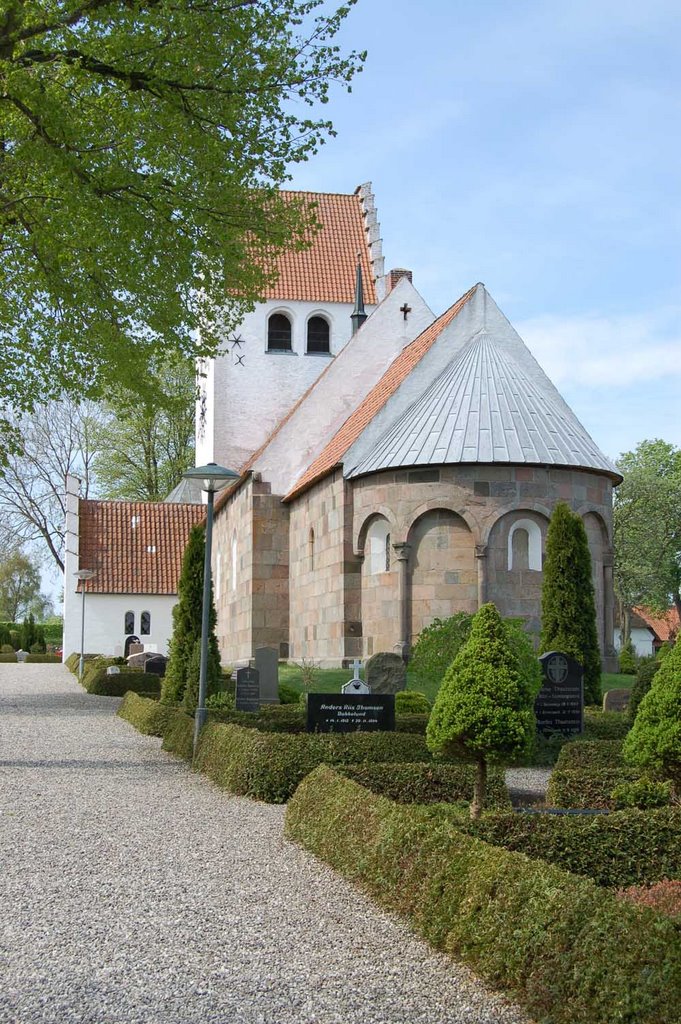
Harre church/ Harre kirke, Harre herred, Viborg amt.

Harre church, ab. 18 km northwest of Skive.


Harre parish, Harre herred, Viborg amt. 


Harre church has a Romanesque nave and choir and two new additions: a tower to the west and a porch to the north. The Romanesque section is in granite ashlars upon a bevelled plinth. An original window upon the north side is bricked. The north door is remade and bricked-up in present time. The southside was rebuilt in 1886 and the south door has ddisappeared. The choir arch with profiled kragsten is possibly rebuilt during a restoration of the inside in 1888. Choir and nave have a beamed ceiling. The tower is in bricks with four pointed gables and a slate roofed spire in the middle. It was built in 1869 instead of a Gothic tower. The tower room functions as a front hall, and the earlier porch - a brick building from the 1800s - is changed in 1931 into a mortuary. The church, which was latest restored in 1951-52, stands in blank wall and is partly roofed with lead.

Communion table panel with paintings from 1617. Altarpiece in Renaissance with biblical painting, repaired 1952. Romanesque granite font in West Jutland (Thybo) type. A baptismal dish in Nürnberg-type from ab. 1550. Pulpit in Renaissance-style from 1621 with decorations from 1715, repaired 1952. New pews. Upon the north wall of the nave is a crucifix-group in Baroque. An organ is placed upon a gallery above the front hall. The bell was cast in 1447 by mester Petrus, citizen in Randers. A rapier, which hangs in the front hall, probably origins from an officer's funeral. A medieval gravestone with a cross lies under the door of the mortuary.

News from Harre church. The church got a model of a Viking ship and their own coat of arms of the district in 2011. Look at their website (Harre kirke -Harrevigegnen) with many information-links (and photos).  


Harre vig


Southwest of Harre kirke in a hilly terrain lies, close to Harre vig, the ruin of Frue Kirke (Our Lady) an almost 21 m long Romanesque building, consisting of choir and nave. The kept foundations were examined in 1929. The church was mostly built in granite, but there were some bricks. In the choir were rests of a monk brick floor. A sunken road at the ruin is called Kapeldalen (the Chapel valley) and the hills around it called Kapelbakkerne.

In Harre vig was the first oyster bank discovered in 1851.

Lysen havn  at Lysen odde was in the 1600s and 1700s a very used disembarkation-place. Skive town complained about it.

Listed prehistorics: 15 hills, of which two lie in three groups between Harre and Dalstrup; 4 are very large, the same goes for Lynghøj west of Harre. At Harre vig are two oval earth banks (listed), they were probably boat sheds for Viking ships.
Demolished or destroyed:  73 hills, they mainly formed a broad stripe through the middle section of the parish.

Names in the Middle Ages and 1600s: Harre (1386 Harre, 1488 Hare); Sønderup (ab. 1340 Sintorp, 1610 Offuer-, Neder Søndrup); Dalstrup (1386 Dalstorp); Harregård (1524 Harregardt); Østergård (1610 Østergardt).


Source: Trap Danmark, Viborg amt, 1962.


photo: borrowed from Google earth 2013, gb 

Friday, August 07, 2009

Grønbæk church / Grønbæk kirke, Lysgård herred, Viborg amt.


Grønbæk Church, 14 km northeast of Silkeborg
Grønbæk sogn, Lysgård herred, Viborg amt.


Grønbæk Church is especially known for its Romanesque frescoes in the apse-vault, but the church is also rich in Romanesque granite sculpture. As for the architecture the church is a rare example on a Jutland granite church where the new building material, burnt stones, were used for the finish of the building. The church yard is one of the prettiest in Jutland.

The Romanesque apse, choir and nave were built in granite ashlars ab. 1225 . Some original windows in apse, choir and nave are preserved. The frame stones around the bricked-up south door are decorated with animal figures, i.e. a dragon as a symbol of paganism opposite God's lamb. Upon the southside under the roof is a strange relief with a troll sneaking towards two people. The long granite ashlar ends in a bearded male head. The tower is from the late Gothic period built in ashlars and monk bricks. In the west window of the tower a modern glass-painting . The porch is from 1907.

In 1903-04 were Romanesque frescoes brought to light; they were restored in 1905, cleansed and repaired in 1956. The frescoes are contemporary to the church building, from ab. 1225. The decoration covers the whole apse-vault, and the pictures were undoubtedly painted immediately after the finish of the church building. All figures have stucco haloes, which probably were gilt originally. Two fields in the apse are dominating with two mighty, smiling, winged animal figures, the Lion of Mark and the grinning Oxen of Luke. The window niches are decorated in winding leaves and flowers. The frescoes in the apse in Grønbæk Church are a unique work of Romanesque art.

Inside are also interesting Romanesque stone pictures upon the kragbånd of the choir, i.e. a fire-breathing dragon and human figures; the dragon is kept back with a firm grib in the tail by God's hand. The colossal baptismal font in limestone is a Gotland work from the beginning of the 1200s. A granite communion table with a cross from 1906. New altar rails in wrought iron. A chasuble from 1725 with a silver embroidered crucifix. A rich Bruskbaroque pulpit with Evangelist figures in high relief, a contemporary entrance and sounding board from 1686 with relief carved initials R T F K I D M. Many memorials in the church, epitaphs etc. A church bell cast in 1485.


figures from the pulpit.


pulpit and crucifix in apse


figures from old altar piece


kragbånd with dragon and lion.


Romanesque frescoes, Lion of Mark and Oxen of Luke.


A unique church with a pretty church yard.

Names in the Middle Ages:
Grønbæk (*1231 Grønæbec); Brårup (*1231 Brothærthorp); Roe (*1231 Rythæ, 1525 Roy); Ris (*1394 Riisz); Naderup (*1425 Naderup); Kongensgård (*1444 Kongensgard).

The farm Ris was in 1394 conveyed by Peder Høeg to hr. Jens Nielsen Løvenbalk, who in 1412 sold it to Alling kloster.

Just outside Grønbæk was a sacred spring, Vissenkilde.

The vicarage's stuehus (living house) , which is listed in class B, was built in 1757 by provst Niels Hurtigkarl, who according to tradition saw to the production of the 54 cm long bricks and other formstones himself.

West of Grønbæk was excavated a ruin, the so-called Erik Glipping's Hunting-house, consisting of the foundation of a medieval building, in raw and cleaved granite boulder (inside measures ab. 11 x 6,5 m). The place shows no sign of fortification.

Listed prehistorics: 13 hills, all small or medium size.
Demolished or destroyed: 39 hills,east of Roe was a large group of 15-20 hills, and a close group of now over-ploughed 5 hills were north northeast of Roe.

Source: Trap Danmark, Viborg amt, 1962; Niels Peter Stilling, Danmarks kirker, 2000.


photo Grønbæk kirke May 2006: grethe bachmann