Showing posts with label unique vicarage. Show all posts

Friday, December 16, 2016

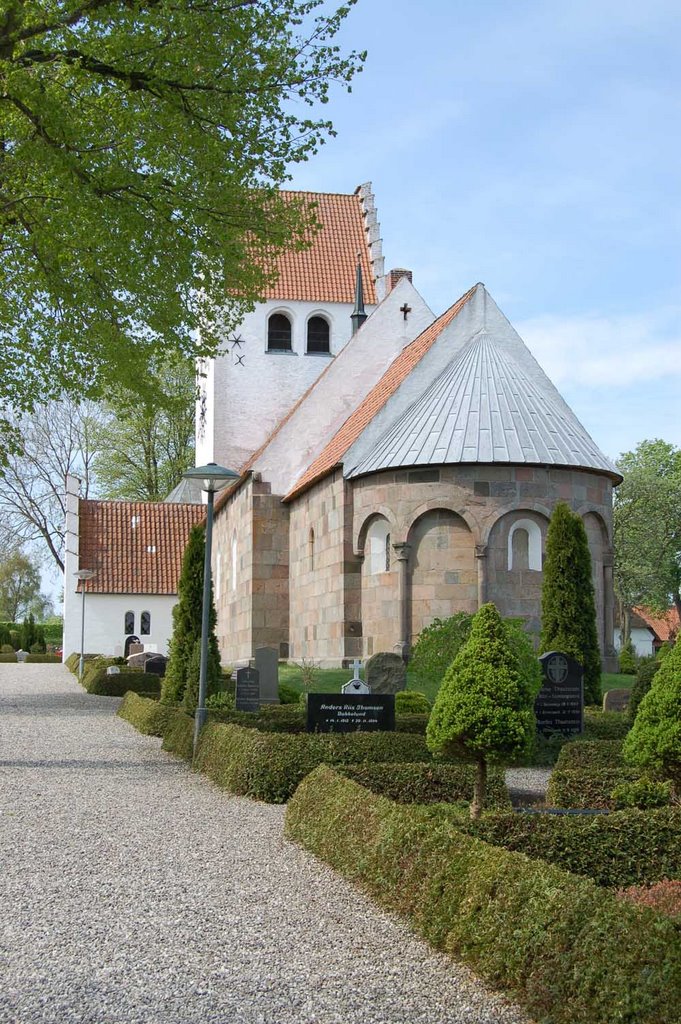
Sindal Old Church, Vendsyssel, North Jutland


Sindal Old Church lies upon a hill in the eastern outskirt of Slotved skov. The earliest part of the church is from the 1100s. In the late Gothic period 3-400 years later the nave was extended to the west which got a stepped gable. The porch was built at approximately the same time. The choir is built in granite ashlars, while the nave mainly is in monk bricks. At the eastern gable are two heavy supporting pillars. The nave and choir have beamed ceilings. The beams in the choir are some of the earliest things in the church and therefore not overpainted.


A reliquary was found in the medieval bricked altar table. It is now at Hjørring Museum. The
granite baptismal font is probably as old as the church itself, the baptismal dish is made in Nürnberg in the 1500s. The crucifix at the northern wall and the candelabres upon the altar table are from before the reformation. The altar chalice was given by the last selvejerbonde (yeoman) of the parish, judge Lars Fus in Taagholt in 1577. The altarpiece is a simpe Renaissance work, the painting is by the Skagens-painter Michael Ancher, who has copied the Spanish court-painter Velasquez' painting "The Crucifixion".


The pulpit from ab. year 1600 has the coat of arms of Anne Krabbe and her two husbands Aksel Viffert and Jerck Kaas. The same coat of arms are seen upon some lord-of- the-manor stools in the back of the church. These stools are the rests of the former pews which was set up by the owner of Baggesvogn, Anne Krabbe. Upon another stool is seen the coat of arms of Sophie Sandberg and Enevold Kruse and the year 1636. Enevold Kruse was Lieutenant colonel and field commander under Christian IV, he was killed in the battle at Lutter am Barenberg in 1626, nine years later his widow bought Baggesvogn, to which Sindal church belonged.

In 1964 the church went through a thorough restoration, new pews were bought and a new organ (Frobenius), and some of the old pews from Anne Krabbe's time were moved to the west end of the church.


Upon the church yard is a bell frame with two bells ,the oldest is made by the caster Peder Lavridsen in 1566, the other with the names Claus Unger and Barbara Galt is from 1696. The church yard is surrounded by an ancient granite boulder dike to the north and south, which is unchanged, but to the east and west the dike has been moved out to make place for a larger church yard.

The vicarage lies south of the church yard , a very pretty timbered building with a thatched roof. The present vicarage was built in 1928 upon the plinth of an earlier vicarage. A section of the old vicarage was rebuilt in the museum-garden in Hjørring as a part of the museum.

source: "Sindal Gl. Kirke - en beskrivelse", udgivet af Sindal Menighedsråd, 2005


Friday, August 07, 2009

Grønbæk church / Grønbæk kirke, Lysgård herred, Viborg amt.


Grønbæk Church, 14 km northeast of Silkeborg
Grønbæk sogn, Lysgård herred, Viborg amt.


Grønbæk Church is especially known for its Romanesque frescoes in the apse-vault, but the church is also rich in Romanesque granite sculpture. As for the architecture the church is a rare example on a Jutland granite church where the new building material, burnt stones, were used for the finish of the building. The church yard is one of the prettiest in Jutland.

The Romanesque apse, choir and nave were built in granite ashlars ab. 1225 . Some original windows in apse, choir and nave are preserved. The frame stones around the bricked-up south door are decorated with animal figures, i.e. a dragon as a symbol of paganism opposite God's lamb. Upon the southside under the roof is a strange relief with a troll sneaking towards two people. The long granite ashlar ends in a bearded male head. The tower is from the late Gothic period built in ashlars and monk bricks. In the west window of the tower a modern glass-painting . The porch is from 1907.

In 1903-04 were Romanesque frescoes brought to light; they were restored in 1905, cleansed and repaired in 1956. The frescoes are contemporary to the church building, from ab. 1225. The decoration covers the whole apse-vault, and the pictures were undoubtedly painted immediately after the finish of the church building. All figures have stucco haloes, which probably were gilt originally. Two fields in the apse are dominating with two mighty, smiling, winged animal figures, the Lion of Mark and the grinning Oxen of Luke. The window niches are decorated in winding leaves and flowers. The frescoes in the apse in Grønbæk Church are a unique work of Romanesque art.

Inside are also interesting Romanesque stone pictures upon the kragbånd of the choir, i.e. a fire-breathing dragon and human figures; the dragon is kept back with a firm grib in the tail by God's hand. The colossal baptismal font in limestone is a Gotland work from the beginning of the 1200s. A granite communion table with a cross from 1906. New altar rails in wrought iron. A chasuble from 1725 with a silver embroidered crucifix. A rich Bruskbaroque pulpit with Evangelist figures in high relief, a contemporary entrance and sounding board from 1686 with relief carved initials R T F K I D M. Many memorials in the church, epitaphs etc. A church bell cast in 1485.


figures from the pulpit.


pulpit and crucifix in apse


figures from old altar piece


kragbånd with dragon and lion.


Romanesque frescoes, Lion of Mark and Oxen of Luke.


A unique church with a pretty church yard.

Names in the Middle Ages:
Grønbæk (*1231 Grønæbec); Brårup (*1231 Brothærthorp); Roe (*1231 Rythæ, 1525 Roy); Ris (*1394 Riisz); Naderup (*1425 Naderup); Kongensgård (*1444 Kongensgard).

The farm Ris was in 1394 conveyed by Peder Høeg to hr. Jens Nielsen Løvenbalk, who in 1412 sold it to Alling kloster.

Just outside Grønbæk was a sacred spring, Vissenkilde.

The vicarage's stuehus (living house) , which is listed in class B, was built in 1757 by provst Niels Hurtigkarl, who according to tradition saw to the production of the 54 cm long bricks and other formstones himself.

West of Grønbæk was excavated a ruin, the so-called Erik Glipping's Hunting-house, consisting of the foundation of a medieval building, in raw and cleaved granite boulder (inside measures ab. 11 x 6,5 m). The place shows no sign of fortification.

Listed prehistorics: 13 hills, all small or medium size.
Demolished or destroyed: 39 hills,east of Roe was a large group of 15-20 hills, and a close group of now over-ploughed 5 hills were north northeast of Roe.

Source: Trap Danmark, Viborg amt, 1962; Niels Peter Stilling, Danmarks kirker, 2000.


photo Grønbæk kirke May 2006: grethe bachmann

Tuesday, March 03, 2009

Astrup church /Astrup kirke, Ning herred, Århus amt.


Astrup kirke, ab. 15 km south of Århus

The church has a Romanesque choir and nave in granite ashlars, while the bottom of the tower to the west is Late Gothic, the porch in monk bricks to the south is from the reformation period, the sacristi from the 1700s and the tower from 1780. The south portal is preserved and in use. It has a tympanum with a human figure between lions and upon the side stones of the door are upright lions. The north door is walled like three Romanesque windows. In the Late Gothic period was built a tower of the same width as the nave but only the bottom is preserved. It is not known when the Late Gothic tower was broken down, but in 1780 a new and smaller tower of bricks was built. Upon its pyramid roof is a funny weathercock of wrought iron with the year 1782.

In Astrup church are frescoes from the 1500s. Upon one vault of the nave is a minuskel-inscription telling that in 1511 this inscription was made in the time of the parish priest Per Nielsen. At the choir arch is a versal-inscription below an emblem "Henricus Stephan Horsnetianus 73 ( probably 1573). The altarpiece is a painting from the late 1800s. The granite font is from present time like the pulpit. The bell from 1698 was cast by Peter Christoffer Geiger, given by admiral Janus Rodsteen.

Astrup vicarage was built in 1777.


Søren Munk (Vinranke-munk) is mentioned 1543 in Drammelstrup. Drammelstrupgård was from the Crown sold to Mogens Friis.
Erik Bruun bought in 1316 estate in Løjenkjær by exchange with Ring Kloster.

There are no listed prehistorics in the parish, but there were 3 hills. 

Names in the Middle Ages:
Astrup (1544 Astrup); Ask (1499 Ask, 1560 Aske); Bøgeskov (1580 Bøgiskouff); Løjenkær (1316 Lotenkier, 1580 Loienkier, Løyenkier); Drammelstrup (1479 Dramestropp, 1499 Dramelstrup); Rasborg (1610 Radtzborre). 

Source. Trap Danmark, Århus Amt, 1963.

photo Astrup 2004: grethe bachmann