Showing posts with label passage graves. Show all posts

Sunday, September 08, 2013

Jungshoved church/ Jungshoved kirke, Bårse herred, Præstø amt.


Jungshoved church, ab. 8 km southeast of Præstø( photo gb


Jungshoved church The church at Jungshoved lies close to the shore of Jungshoved cove, just outside the castle bank of (not (demolished) Jungshoved castle. The church has a late Romanesque choir and nave from ab. 1225-50 in small limestone ashlars and monk bricks with a tall profiled plinth . In the choir is one and in the nave two bricked-in windows, visible from the loft, in the choir is a bricked-in priest's door, the round-arched door of the nave sits in a protruded portal. In the early Gothic period the nave got a western extension in limestone ashlars with a few belts of monk bricks.Its gable was rebuilt ab 1450 in monk bricks. In the late Gothic period the south side of the choir and the eastern corner of the nave had supporting columns; the choir arch was made pointed, and the choir and nave were overvaulted. North of the choir was built a vaulted sacristy in monk bricks, and north of the nave -because of the close coastline - was raised the bottom section of a tower with a western staircase-house in monk bricks, with a few limestone-ashlar belts; in front of the south door was built a porch. In the beginning of the 1600s the upper storeys of the tower were built in small stones with stepped glare gables. In 1882 the whole church got round-arched windows.
photo 2013: gb
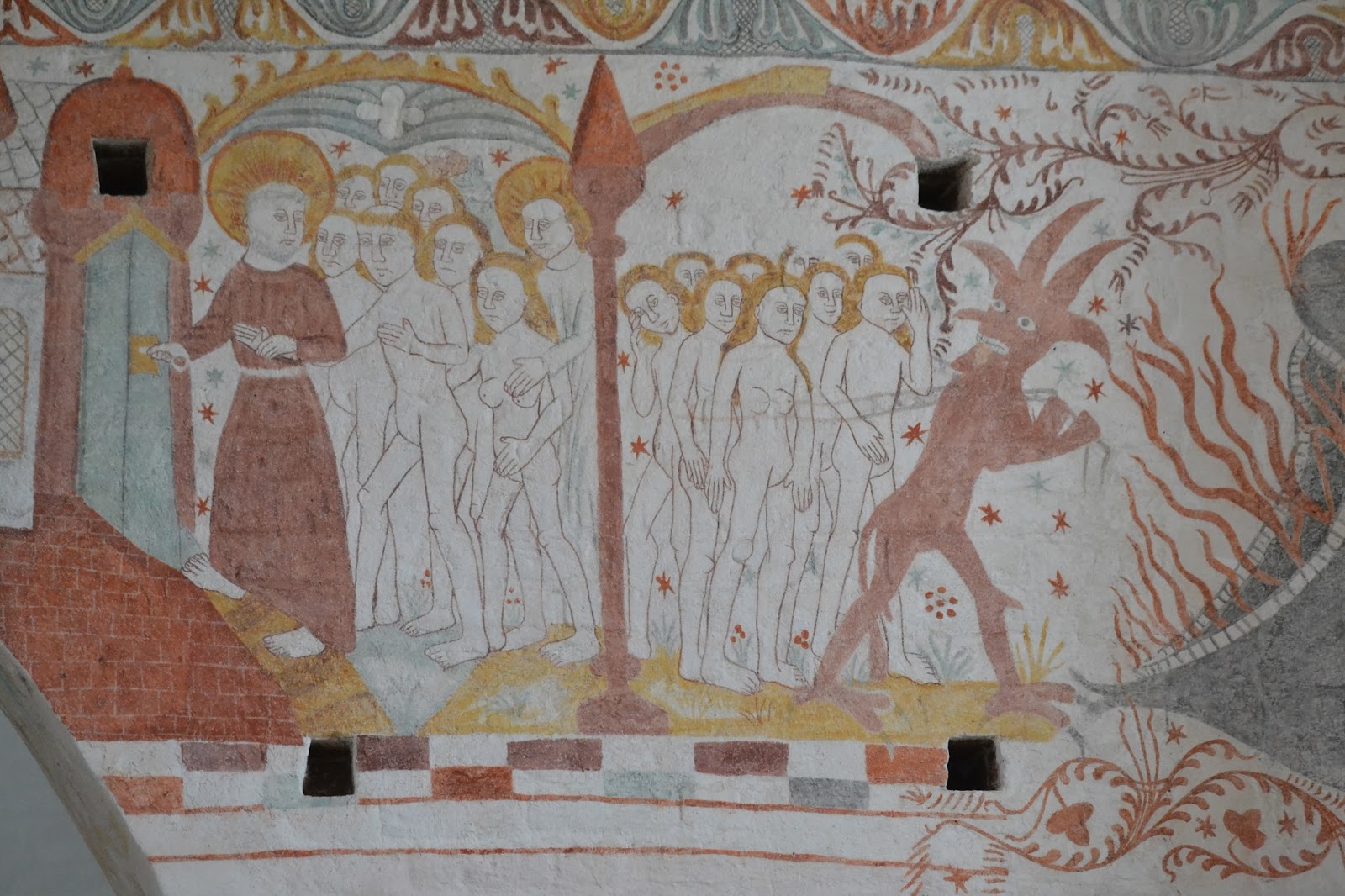
Upon the upper walls of the nave are rests of Gothic frescoes, figures and wining leaves, older than the vaults.

Interior Altarpiece ab. 1590 by "Bårse herred's jointer", it is very re-made with an inserted plaster relif of Thorvaldsen's Christ in Emmaus. Altar candelabres 1649 with the coat of arms of the vasal Ove Gedde (Gjedde) and wife Dorte Urne. Late Gothic procession-crucifix ab. 1510-20. A square font in burnt clay with reliefs by Thorvaldsen, rest of a medieval Gotland limestone font in the porch, a Netherland baptismal dish ab. 1625. High Renaissance pulpit ab. 1605-10, from the Schrøder workshop in Næstved, with Evangelist-statuettes. Chandelier ab. 1600. Bells: 1616 by Hartvig Quellichmeyer and 1897 by Løw og søn. The tower room was furnished in the 1780s as a burial chapel for the Brockenhuus family, above the door a stone tablet with the coat of arms of Brockenhuus and Holstein. In the chapel two similar sarchophagus in Norwegian marble, made in 1787-88 by Johs Wiedewelt. Here rest the district commander Hendrick Adam Brockenhuus (+ 1803) and wife Elisabeth, née Holstein Ledreborg (+ 1786).

Jungshoved, small marina downside church and bank 2013: gb
Jungshoved manor. In Valdemar Jordebog is mentioned "junxhoulæth". From chiefs and vasals are known - the earliest especially from the Hanse-recesses - ridder Otto v Budelsbak (1364-71), Henning v d.Lancken (1376), ridder Jens Rud the Elder, mEntioned 1390, gave back the vasalry in 1393, Mogens Gøye (ab. 1440), ridder Korfitz Rønnow (1474-86), Ebbe Mogensen Galt (1494- 1526), his son Anders Ebbesen Galt, with whose widow the vasalry came to her 2. husband Børge Trolle of Lillø. He was in 1571 replaced as vasal by rigshofmester Peder Oxe until (1574), among the following vasals were rigshofmester Christoffer Valkendorf (1583-87 and again 1597-1601), Mourids Podebusk, who was infamous for his brutal behavior of the peasants (1589-94) and admiral Ove Gedde (Gjedde).
Jungshoved church, 2013: gb
Chr IV had a stutteri at Jungshoved, which in 1628 was said to be very delapidated - and it suffered much damage during the Swedish wars. The manor was plundered, the woodwork burnt down and the libray-books of Jørgen Reedtz were  stolen. The local legends origin from this period, about the peasant Svend Poulsen's (= Svend Gønge)  exploits in and around Jungshoved, which formed the starting point of Carit Etlars novel "Gøngehøvdingen". In 1665 Jungshoved was deeded to greve Christoffer Parsberg, who in 1671 exchanged it for Torbenfeld. to prince Jørgen (+ 1708), Chr. V.'s brother, who had got Vordingborg district for life (form of vasalry). After the prince in 1683 had married the English princess Anne ( died in 1714 as queen of England), and had settled in England, he let his property in Denmark manage by Chr. Siegfried Plessen, in 1714 Jungshoved was taken over by the Danish Crown and was incorporated in the rytterdistrikt equestrian district of Vordingborg. The estate was in good condition, but the castle did not exist anymore. In 1761 Fr.V. sold Jungshoved and Oremandsgård to Henrik Adam Brockenhuus, who bought Nysø in 1763, with which estate Jungshoved later was united.

Jungshoved castle bank, photo:gb
Jungshoved Voldsted (Castle Bank)   In the southwestern part of the parish, close to the beach and by the inlet to a small cove between and dividing  Jungshoved parish and Allerselv parish, about 60 m south of the church, lies Jungshoved Voldsted ("Slotsbakken"), an irregular and steep, about 47 m broad and about 5 m high bank, which uneven surface covers foundations of the castle. Nothin is known about the earliest castle buildings - but once were some timbered buildings 1) "The new House" with the king's rooms 2) " The old House" with the ladies room, two bay windows and a staircase-tower with spire etc. and 3) likewise an old house with stegers=kitchen,  bryggers = scullery and some chambers, and beside and free on the 4th side was a one storey house, where the managerhad a room. The castle was probably in ruins from ab. 1660. The last building seems to be broken down in 1714, and all was left was the farm building and a manager's house. In 1717 the rest was broken down and the materials were used for stables and baraks in Vordingborg. On the actions of the National Museum was in 1894 cut a crossroad through the thicket on the almost overgrown castle bank. The foot of the bank is surrounded by an almost overgrown moat and around this is a lower bank, which south and east side again is covered by a moat, which leads out to the beach. Around the church were found building remains which were said to be from an earlier village, but they probably origin from the farm building of the castle. The castle is very old, but nothing is known about its earlier history.

Roneklint, lighthouse and entrenchment, 2013: gb
North of Roneklint lies a entrenchment by the beach "Gamle Batteri".

Jungshoved parish seems to have been an island in ancient times between Præstø fjord and the cove on the southwestern border where lie bogs and water streams - and the inhabitants call the place "Øen" ( the island) The parish, of which a part was called Smidstrup parish in the 1400s, was an independent parish with own priest, but in 1718, when the vicarage burnt down, it became an annex of the town Præstø, until it again became an independent parish in 1762.


Listed prehistorics: In Bønsvighoved skov is a long dolmen and 2 passage graves, of which one "Svend Gønges Hule" is wellkept. At Stavreby the hill Mislehøj.

Demolished or destroyed: a passage grave and 2 other stone graves, all at Bønsvig and 26 hills, of which 18 were in an oblong group east of Ambæk.

Upon low water outside Jungshoved castle bank is a settlement from Ertebøllekulturen.

Source: Trap Danmark, Præstø amt, 1955   
Text (translated) and photo Jungshoved 2013: grethe bachmann 


Thursday, July 18, 2013

Fanefjord church/ Fanefjord kirke, Mønbo herred, Præstø amt.


Fanefjord kirke, stig bachmann nielsen, naturplan.dk


Fanefjord church is one of the most important cultural and historical churches in Denmark. It lies upon a hillside at the island of Møn with a beautiful view to the fjord, which gave it its name, Fanefjord. The waters of the fjord are a section of a sound called Grønsund. From the church is a view across the waters

to the island of Falster - and the large church can be seen far and away at the western part of Møn. The placement of the church at an unusual   distance from the villages must be due to that the original church was built on royal initiative. The parish itself lies over 2 km from the church like the vicarage in Vollerup.


Fanefjord
In the bay downside the church it is supposed that the war fleet of archbishop Absalon and king Valdemar  met in the 1160s before their attack on the Wends on the other side of the Baltic Sea. Valdemar built a castle tower by Fanefjord which was never proved archaeologically, but the castle site probably hides on the south side of the bay. Here was a small, but international herring market at that time. The original church served the king and the merchants before it served the local population

Fanefjord church is famous for its frescoes from the late 1400s which are the main work of the artist known as the Elmelunde-master. The large church with two naves was built in the second half of the 1200s as a successor of a royal church (probably a wooden church)  at the castle and the market place at Fanefjord.


Fanefjord church was inaugurated to Sct. Nicolaus. It has a longhouse with  a triangular eastern finish, a tower to the west and a porch to the north, all in monk bricks. The western section of the longhouse is the over 7 m high nave from an early Gothic church from ab. 1250-1300; the longwalls are squared by slender supporting columns. In the westernest bay to the north was until 1931 kept a 3,18 m high point arched window in each wall, there were only three windows in each wall, since the next westernest bay is dominated by the doors, of which the southern is bricked-up, the northern has a pointed arch. The western gable, which is hidden by the tower, has three point arched glares, the triumph arch is pointed and upon the east side of the wall are traces from an earlier choir, which like the nave seems to have had an original vault. In three of the nave's corners are small corner columns and upon the longwalls, similar to the outer bay division, are small lisens, which do not belong to the present vault.

Considering the big broadth of the nave it is probable that it was two-naved like the church in Stege. The present 2 x 4 cross vaults, which are carried by three arcade pillars dividing the nave, are from the late 1400s - and the longhouse choir from the beginning of the 1500s. Its triangular eastern finish is possibly influenced by Stege church's latest choir plan, the polygon-corners have small supporting pillars, and to the northeast is a point arched glare, to the southeast a bricked-up window and to the south a point arched, but remade door. The polygonsides are finished by a common gable with a horisontal glare decoration. Contemporary to the choir is the remade porch and the tower, which "wrong" gables (south-north) have a mighty rise and a glare system,which reminds about the one of the choir. The vaulted tower room, which opens to the nave in two point arched arcades, has to the south a point arched window. The tower stairs lie to the north. The present round arched windows of the church origin probably from a repair in 1724. The possibly late Gothic fence-wall, which follow the edge of the church hill is broken to the south by a flat round arched portal.


The Frescoes:
When you enter the church room you are overwhelmed by the rich picture bible in the vaults and on the triumph walls. The frescoes in Fanefjord are some of the most important frescoes in a Danish church. Except the frescoes in the middle of the choir arch, which are from the 1300s, the rest of the frescoes are made by the Elmelunde-Master in the late 1400s - and the paintings in Fanefjord church are his main work. His other works can be seen in other chuches on Møn, Falster and Lolland, like in Keldby and Elmelunde etc.
His characteristica is the simple humoristic description of the biblical scenes with clothes and buildings from the 1400s - and contemporary types of people. Except for the dresses his image of people are without actual personal features. Common for each and everyone, both Christ and the simplest sinner, are the large wide eyes, which give the persons a rather simple-minded appearance. His colours are warm, especially the variations of red with details in green, yellow and black. 


pulpit

Gotland limestone font
Interior Freestanding communion table is built in monk bricks, the altarpiece was made in ab. 1630 by the jointer, who was also the master of the pulpit in Stege church, the original decoration was brought to light in 1934. A figure of Maria with child origins from ab. 1300, it is now in Stege museum. Late Gothic altar candelabres ab. 1550. An early Gothic baptismal font in Gotland limestone, a South German baptismal dish,  ab. 1550-75, a pulpit in same type as in Elmelunde church and probably by the same master, contemporary sounding board, a baldacin below it from 1934. Upon the northside of the nave and the choir are closed Renaissance pews  from ab. 1600, almost similar to the now destroyed pews in Keldby church, besides are some early and newer gable-planks from various pews, which now are in Stege museum. Iron bound moneyblock 1756, four money tablets. Bells: 1) cast 1495 by Olaf Kegge, 2) 1826 by J.C. and H. Gamst, Copenhagen.


Parish history:
In the parish was in the old days, according to a report of Hans Viborg in 1679, a chapel at Hårbølle, and here was a monument Pilgrimsstenen (Pilgrim Stone), formed like a coffin and with a cross upon each hollowed corner and probably also with a crucifix.


North of the ferry place in Hårbølle at Hestehaven is a rectangular castle bank or a fort, which to the south and east has rests of  surrounding moats.

North of Fanefjord lies the castle bank Borgsted which during 1. World War was reshaped ino a military site. It was until then only a flat oval rise (60x65) with traces of a surrounding moats, according to early descriptions there were towards land double moats with a bank between, a well was found and ceramic pieces from ab. 1300 and rests of a wooden bridge, which lead across the moat, but no foundations. This might have been the site of the castle Nyhus (Prince Vitslav's castle),  which was often confused with Stegeborg, it defended itself against the Norwegian fleet and Marsk Stig's attack in 1289. The castle was probably originally laid out for defense of the ferry place to Falster, and from the same reason was also the field-work, which is seen in the ferry-farm's garden . 


In Askeby is found a somewhat levelled castle bank Hovgården, which square castle bank 60x60 was once surrounded by moats  and probably also banks. Charcoal has been found, but no rests of buildings. According to the legend a "Kong Kat" lived here.

At the foot of the hill Præstebjerg was a sacred spring Blåkilden

In the border to Kokseby was a large carved granite boulder Pilgrimsstenen, probably the same as is mentioned in Hårbølle chapel above, to which was connected a legend about Truels' daughters from "Ridder Truels Borg" or "Kokseby Slot". It is certain that in Kokseby was a larger farm, and a farm in the village is still called "Slottet", where were found rests of walls etc. Fru Grethe Rebers (?) of Kokseby Slot was burnt on the stake in the 1400s.

In the parish was a village called Bredemad  in 1596, which in the 1600s was said to have 6 farms and 1 house. Besides is mentioned a village Pested in 1429.


Green Hunter's Hill detail.
Green Hunter's Hill (enlarge)
Listed prehistorics: south of Fanefjord church lies one of the largest long dolmens in Denmark Grønjægers Høj ( the Green Hunter's Hill) or Grønsalen (the Green Hall): 102 m long, 2 m high, with an almost flat surface , with 3 chambers, surrounded by 134 closely placed very large edge stones. According to tradition Dronning Phane ( Fane) and King Grøn (King Green) were buried here.  Upon Vollerup mark 2 dolmen chambers with cover stones , 13 hills most of them in the forests.

Destroyed: 4 long dolmens 6 indefinable dolmens, a passage grave and 73 hills.

In a moor east of Hårbølle were found 16 pretty flint daggers. In Hårbølle Hestehave was examined a burial place from late Bronze Age with ab. 40 graves.

Names from the Middle Ages: Fanefjord (ab. 1370 Fanæfyorth); Vindebæk (1513-33 Wynnæbæck, 1596 Windebeck); Hårbølle (1513-33 Harrebølle, 1596 Harbølle); Vollerup (1562 Vollerup); Kokseby (1429 Koxebye); Store Damme (1513-33 Damme, Dammæ); Tostenæs (1422 Tostenes, 1462 Tostnæs); Lerbæk (1596 Leerbeck); Askeby (1596 Askebye); Hovmarken (1429 Hovemark).

Source: Trap Danmark, Præstø amt, 1955

photo: grethe bachmann and stig bachmann nielsen, naturplan.dk

Thursday, June 06, 2013

Stouby church/ Stouby kirke and Rosenvold, Bjerre herred, Vejle amt.


Stouby church, ab. 15 km east of Vejle, photo: gb


Stouby kirke
The large whitewashed church in Stouby is in its present look a Gothic longhouse building with a tower to the west and a porch to the south. From the original Romanesque travertine church is left only the northside of the nave with a late Romanesque extension to the west. A single round arch window is seen as an outside niche, the extension, which wallwork is thicker than the original wall, has in the top a frieze of narrow *lisens. In the Gothic period, probably ab. 1400-1450, the building was reshaped into a longhouse with a triangular choir finish, which in the east wall has a *firpasblænding. The high, light room has inside four cross vaults with profiled ribs and very narrow *gjordbuer and a half star vault in the choir section. The tower to the west in monk bricks is a little newer than this rebuild, and it lost its vaults at a later date - there is now a beamed ceiling in the tower room, which opens toward the nave in a new tower arch. Its upper sections are cut down till a little above the height of the nave, probably in 1817 (iron numbers  and initials for F.Rantzau). The tower stairway  is in the southwest corner of the nave. The building was restored 1877 and the porch origins from this time.

* lisens = protruding pilastres/bands
* firpasblænding = a glare similar to a fourclover
* gjordbue = a reinforcement curve of a vault


Interior: In the choir are 4 pretty mosaic windows from 1952 by Kresten Iversen. The altarpiece is a skilled carving from 1731 , it was given by Dean Jørgen Knudsen Beesche and made by Jens Jensen or Jørgen Slache. An altarpainting, copy  after Carl Bloch, hangs in the porch (1964). Chalice 1786, given by Carl Adolph Rantzau and Christiane Ernestine Frederiche Vedel. A Romanesque granite font with four horisontal angels, one is Sct Michael, fighting a monster. A pulpit in late Renaissance 1640 with old decorations. A bell from 1708, Friderich Holtzmann.


Rosenvold slot, photo: gb
Rosenvold is mentioned the first time in 1575 when Karen Gyldenstierne, widow after Holger Ottesen Rosenkrantz of Boller and their heirs at R. had permission to seek to Stouby church, while the ealier owners of R. had seeked to Barrit church.  Their son Frederik Rosenkrantz is written of the farm in 1599, but he was exiled the same year because of his relation to Rigborg Brockenhuus and died in 1602. His brother Otte Christoffer Rosenkrantz took over R., but at his death in 1621 R. and Boller had, because of debt, to be sold to Ellen Marsvin, who inn 1630 had to give the farms to her daughter Kirstine Munk. She died in 1658 and her daughter Elisabeth Augusta sold R. in 1660 to stiftamtmand, gehejmeråd Henrik Rantzau (+ childless in 1674). The farm was inherited by his brother's son  kammerherre Henrik Rantzau (+ 1687), his brother grev Otto Rantzau (+ 1719) the son generalmajor grev  Frederik Rantzau (+ unmarried 1726), his brother viceroy in Norway, grev Christian Rantzau (+ 1771), who in 1756 established "Det grevelige Rantzauske Forlods af R".   

Later owners: The family Rantzau up till present.


Rosenvold, the main building is listed in class A.

Some extra details in history: 
The castle ruin is still seen in the forest northeast of Rosenvold. Staksevold was probably withdrawn and broken down by queen Margrethe I in her work of gathering Denmark and the Nordic countries in the second half of the 1300s.

In front of the coast banks on the low meadows towards Vejle fjord and a few hundred meters from the sea Karen Gyldenstierne built her dower house Rosenvold in 1585. Before this her husband Holger Rosenkrantz had established Rosenvold as a main farm ab. 1570. He had bought the areas of the earlier Staksevold, a "røverborg" (robbers' castle), which was a stone tower with a bank and moat and outside with wooden buildings and a stable.
At the death of Karen Gyldenstierne her two sons took over Rosenvold, first Frederik Rosenkrantz, who run into bad luck because of his relation to the queen's Lady in Waiting Rigborg Brockenhuus from Egeskov. As a punishment she was immured at Egeskpov, while Frederik contracted the wrath of the king and was exiled. His brother Christoffer took over the estate, but he got some economic problems and had in 1621 to sell Rosenvold to Ellen Marsvin of Holckenhavn , wjo was the big collector of estate at that time and the mother-in-law of Christian IV. In 1630 Ellen Marsvin was at the kings command ordered to give Rosenvold to her daughter Kirsten Munk, since she was banished from the court after having refused the king access to her chamber. Kirsten Munk's heirs had to sell Rosenvold in 1660 to Henrik Rantzau of Schönweide in Holstein and stiftamtmand in Århus. The Rantzau family is still the owners of Rosenvold and has been for almost 350 years. (source.: Rosenvold.dk/)  


Rosenvold Marina, photo:gb

Gravengård etc was by hr. Oluf Stigsen (Krognos) pawned in 1497 to bishop Niels Clausen in Århus, later it belonged to the son hr. Mourids Olufsen (Krognos)(+ 1550), with whose daugther it came to Holger Rosenkrantz of Boller in 1662. G was from Boller laid out to Gabriel Marselis at Havreballegård.

The medieval castle bank Gravengård was situated close north of Lille Gravengård about 500 m northwest of Stouby kirke.  A farm was earlier  situated at the castle bank. After a fire in 1926 the farm was outparcelled and the site was levelled. The castle bank lay in a pond which water surrounded it on three sides, upon the fourth side was probably a moat. In the 19th century were probably destroyed some banks. Upon the castle bank were buildings in monk bricks.

Rohden was in 1662 two farms belonging under Rosenvold. In 1758 grev Christian Friis (of Vadskærgård) of Frijsenborg deeded both farms to manager Hans Erik Saabye, later of Brantbjerg, and in 1771-72 justitsråd Jørgen Hvass de Lindenplam of Tirsbæk deeded the two farms to Christen Mikkelsen Kjær, who in 1789 only owned one farm, Neder Rohden. This farm his son Jens Kaj Kjær willed shortly before his death in 1826 to his daughter Christiane Kjær, in 1827 m. to Jørgen Hansen, later of Borchsminde.
Later owners: Jacob Lund Eggertsen, Jens Simonsen Buch, Nicolai Jensen Jelling, Johannes Brorson, Flemming Lerche, Folmer Lüttichau.

Niels Jensen of Ullerup is mentioned 1340-46.  

Jysk Nervesanatorium at Vejle fjord, built 1898-99. = Vejlefjord Sanatorium.

According to Pont Atlas Gammelby was originally called Stouby, but since a part of the town burnt down and was rebuilt about 1 km from there, the new town was called Stouby, while the rest was called Gammelby. Since the vicarage lies here, the parish was for a period called Gammelby parish.

forest at Fakkegrav, photo: gb
At the beach were some farms Falsterbo (1664 Falsterboe). Northeast of Hugholm were some houses called Himmerig. From dissapeared farms are Smedegård (1497 Smedegard) in Hyrup and Bjerregård (1683 Bierregaard, Berrgord). Furthermore the houses Knoseborg or Hulvejen (1664 Huolweyen or Knoseborrig), Sanderbækhus (1683 Sanderbech Hues) and Strandhuset (1688 Strandhuuset), de two last mentioned were fisherman's houses. Fakkegrav was earlier named Favrdal (1683 Fougerdal) and later Pakhuset


Listed prehistorics: At Rosenvold is Tehøj in which top are two cover stones, probably for a passage grave, and a somewhat disturbed dolmen chamber. Furthermore a large hill south of the church and two hills in Ullerup skov.
Demolished or destroyed: not less than 19 stone graves, of which two were long dolmens, one with 4 chambers; a dolmen chamber and two passage graves. In Pont. Atalse is mentioned at the vicarage a stone -surrounded hill with several chambers,which the parish priest let abolish.

From Rohden is known a small heap of shells from early Roman period.


Names from the Middle Ages and 1600s: Stouby (1399 Stoby, 1498 Stowby); Gammelby (1498 Gamelbi); Hyrup (1477 Hyrop, Hyrøp); Hostrup (1300s Horstorpmark, 1497 Hostrup); Belle (1459 Bælle); Fakkegrav (1664 Fastjgrau); Stoubyskov (1664 Stoubye Schouff); Hjerrild (1610 Herildtt); Hugholm (1683 Hugholm); Grund (1477 Grwnnæ); Rosenvold (1575 Rosenvold); Rohden (1474 Rode, 1475 Rodhe); Grundgård (1495 Grundegaardtt, Grunegaardt); Rønsholtskrog (1683 Rønsholt Sovhues); Gravengård (1462 Grawengart); Bobæk (1664 Boebech); Over Ullerup (1340 Vgelthorp, 1474 Wllerøp), Stoubylund (1511 Stobylundt); Årup Mølle (1458 Arrvp Mølle, Arwp Mølle) .     


Source: Trap Danmark, Vejle amt, 1964.

photo 2011: grethe bachmann


Tuesday, June 04, 2013

Barrit church/ Barrit kirke and Barritskov, Bjerre herred, Vejle amt.


Barrit church, ab. 12 km east of Vejle.


Barrrit kirke
The church in Barrit origins probably from 1152-1160. It was originally white. The church went through several re-buildings but the present look is from a main restoration in 1879, where the old church was re-walled with red bricks from a demolished tilework in Breth. The placement of the church building is interesting. The area is easy to defend; the brook and the steep banks protect the church towards the north and partly to the east and the west. The church dike was easy to equip with palisades and the church was with its thick walls ( in some places up til 2 m) a safe residence for women and children.
 
Barrit church has a choir with a triangular finish, a nave and a tower to the west and a chapel to the north. The church, which was built in travertine, is marked by a re-bricked with red bricks in the end of the 1800s - so it looks quite like the neo-Romanesque creations of that period. The walls are divided in supporting pillars and have round arched friezes in the top. The inside of the church has no details, but is whitewashed. The choir section ,which in its present look is caused by a choir extension in the 1300s, has a triangular rib vault and a short point arched barrel vault, while the nave has four bays of cross vaults upon strongly protruding wall pillars ( the common East Jutland type from the second half of the 1400s). The tower is late Gothic in its kernel but it seems also re-bricked with its square spire between four glare-decorated pointed gables. The medieval wallwork is only visible in the chapel, but this was also changed during time, like in 1725. The church was restored in 1787 and 1879. A porch on the southside was removed in the big re-build and the entrance was placed in the tower room. Upon the choir arch and in other places are some fresco-decorations  from the restoration-period.

Barrit church, photo Google Earth.
Interior:
A neo-Romanesque communion table. An altarpiece, an oak frame with a painting by J.Thrane 1731, repaired in 1918. A chalice with a Renaissance knot and foot and cup from 1746. Upon the cup the coat of arms and initials for Tønne Reedtz and L.F.Levetzau. Similar oblate box with stamp for Knud Rasmussen Brandt. Horsens. Heavy late Gothic candelabres upon lion feet. A Romanesque granite font with a smooth cylindric basin upon  truncated foot. South German dish ab. 1575. A neo-Romanesque pulpit and crucifix. Bell from 1874.

In the chapel eight coffins with the bodies of the family Reedtz: Tønne Reedtz (+ 1699) and wife; Valdemar Reedtz (+ 1724) and wife; Tønne Reedtz (+ 1743) and wife; and G. Balthasar Samitz (+ 1732) and wife, née Reedtz. Furthermore two burial banners.


Barritskov, photo 2011  gb
Barritskov belonged in 1261 to hr Niels, who founded the Fransiscan kloster in Horsens, in 1314 and 1323 to hr Mogens Jensen, and then to his son Mogens Mogensen, and in 1356-1483 four generations of the fanmily Manderup, all named Niels Manderup and all knights. The last left B. to his daughter Anne Manderup. m. to Christen Holck, who still lived in 1502. Their son Manderup Holck is mentioned as the owner until 1537 ( in an exchange in 1513 he got his sister Sophie's part of B.) and the farm came then to the son Hans Holck (+ 1565) and to his son Manderup Holck, with whom this line of the family died out in 1588, whereafter the sister Kirsten Holck by marriage brought B. to rigsråd Steen Brahe of Knudstrup (+ 1620 ). Their daughter Birgitte Brahe brought it to rigsråd Frederik Reedtz of Tygestrup (+ 1659); whose son Tønne Reedtz (+ 1669) inherited it. His widow Elisabeth Sehested (+ 1705) deeded in 1700 B. to her son Valdemar Reedtz (+ 1724), who was followed by his son Tønne Reedtz (+ 1743), whose widow Lucie Emerentze Levetzau kept the farm until her death in 1774. It then came to her son-in-law statsminister Frederik Christian Rosenkrantz of Rosenholm (+ 1802)

Later owners:  Niels Rosenkrantz(stamhuset Rosenkrantz), Henrik Jørgen Scheel; Frederik (Fritz)Chr. Rosenkrantz Scheel, Henrik Jørgen Scheel,  Knud Henrik Otto Brockenhuus-Schack; J.K.B. Brockenhuus- Schack. 1913-1949, Knud Henrik Otto Brockenhuus-Schack; 1949-1967: Jens Knud Bille Brockenhuus-Schack; 1969-1984 Mogens Harttung; 1984-1985: Mary North married Harttung; From 1985 : Thomas Alexander North Hartung.


Barritskov photo 2011: gb
The old main building, which was broken down in 1914, made a picturesque three-winged plan which individual houses were built at various times in the 1500s. The castle yard lay upon the bank of a small, now dried out lake, upon a narrow square medieval castle bank. (...) Steen Brahe and fru Kirsten built a large living house in two storeys in 1597-98 to replace the old timbered wing to the east. (...) A lower short western wing was built in the 1500s or 1600s as a replacement for the older timbered wing, but it disappeared shortly after 1793. (...) When Fr. Chr. Rosenkrants inherited Barritskov 1774, this ceased being the residence of its owner,  and in the following century the building came into decay. (...) Althoug it showed that there was nothing wrong with the buildings, Barritskov was broken down in January 1914. This was   one of the most painful losses, which the Danish architecture suffered in the 1900s.(...) Knud Brockenhuus-Schack built a new main building, a simple formed two storesy red brick villa, the building is by a short middle building in connection to the lower sidewing to the north,  where the timber from the old timbered building has been used in a decorative way. The inscription tablet of Steen Brahe is inserted in the west gable. Some old panelwork and doors from the old catle yard are used in the dining room and parts of the painted ceiling from 1598 in a front hall.

The big garden was planned by landscape gardener E. Glæsel, the now very overgrown ruins of the old main building are kept from decorative reasons. Tønne Reedtz had west of the old main building established a large French garden, which remains are still seen.

Strandmøllen in Barritskov was in 1356 by Peter Ulfsen Mule sold to Niels Manderup junior.

Staksrode skov photo 2011: gb
In Staksrode Vesterskov, about 300 m from the beach, lies the medieval castle bank Staksevold. It is an almost rectangular middle bank ( 26x34 m) at the foot, surrounded by a now waterfilled moat, which broadth varies from 10 til 19 m. Around the moat is a bank, which to the west reaches a height of ab. 2 m and a broadth at the top of 8 m, while to the east it is only 1 m high and 2,5 m broad. To the northeast the bank is interrupted for letting water in. In the outer foot of the western bank lies a plateau (ab. 50 x 10 m), protected by a dry moat in front.

The National Museum has examined and excavated the castle bank. The ground walls of the original stone house were restored etc..Some planks from a wooden bridge were found and foundation stones from a timnbered building,  coins from the end of the 13th century and from the 14th century, some weapons etc.    

In the parish (Barrit) was a village, named Have (1462 Hawe), which is menrioned several times ab. 1500. Also Stavsøre (1408 Staffør, 1457 Stafsøræ) seems to be the name of a village; the main farm here was deeded by Johan Kalf in 1408 to the Roskilde bishop, who in 1457 exchanged it to hr Johan Bjørnsen (Bjørn). The name is probably found again in Stagsevold (originally Stavsørevold), a name of a castle bank in Staksrode Vesterskov, which supposedly indicates the old situation of Rosenvold(manor) in Stouby parish.

From disappeared farms is mentioned Gammelgård (1443 Gammellgaard) in Barritslund, Tovskov (1502 Tofskoff) and Breth Torp (1408 Brendtorp ,1473 Bredsthorp),  which in 1664 was divided in two farms.

In the edge of the beach south of Barritskov was once a castle bank, which was traceable until a few years ago (since 1964). The sea has wiped away the last rests. The plan is described as a circular castle bank (12 m diameter) and a front castle, both surrounded by moats. A corner of a monk brick building was visible.

Listed prehistorics: 7 stone graves, of which 5 are at Barritskov, and three of these lie in a group upon the field east of the farm, one contains a polygonal dolmen chamber without cover stone, another contains a disturbed passage grave, in Barrit Tykke lies a long dolmen with a disturbed chamber. In Staksrode Skov lie two dolmens with removed chambers. Finally a small hill in Barrit Tykke.

Demolished or destroyed: 18 stone graves and 13 hills, one of the stone graves was known to be a passage grave. All memorials are or were in the southern half of the parish.

An urn grave site from early Roman period is known north of Barrithule, an Iron Age settlement from Korsbækhoved. 


Names from the Middle Ages and 1600s: Over Barrit (1333 Barwith, 1462 Baræth); Barrithule (1356 Barwythole); Barritskov by (1664 Baarit schouffs bye); Breth (1408 Brent, 1458 Breedh, Bredh); Staksrode (1238 Barrit Rud, 1408 Ruthe, 1475 Baruid (t));  Breth Surmose (1426 Smemosze, 1509 Suermoessze); Lavrsgård (1683 Lausgaardt); Gramtange (1546 Gramtange); Barritlund (1443 Baruedlund); Barritskov (1261 Barritzskov, 1323 Barwiithscogh); Rand (1664 Rande); Enemærkegård (1664 Eenemerchet); Korsbækhoved (1683 Korsbech Hofuit)


Source Trap Danmark, Vejle amt, 1964.


photo Barrit church: Google Earth 
photo Barritskov and Staksrode skov 2011: grethe bachmann 


Monday, April 29, 2013

Gærum church /Gærum kirke, Horns herred, Hjørring amt.

Gærum church, ab. 8 km southwest of Frederikshavn.


Gærum parish, Horns herred, Hjørring amt.


The lonely situated whitewashed church in Gærum (Gerum) has a new tower to the west, a nave and choir and a porch to the north. The present nave and choir represent the oldest core, undoubtedly a late Romanesque building in large monk bricks, mixed with some boulder, but there are no safe evidence of the dating. The whole north side is now without windows, earlier was supposed that there was a trace of Romanesque windows, which are not visible now. The church has inside a beamed ceiling, while the choir has a cross vault. At the end of the Middle Ages a tower was built, but it seems that only the bottom storey with a point arched arcade towards the nave was finished. A new tower is built upon this place, whitewashed with a pyramid roof (built 1956-57); and at the same occassion the walls of the nave were enheightened. The porch was built in 1863.

The altarpiece is a Renaissance work from 1602 (painted date of year), undoubtedly given by Vogn Svendsen (Orning) of Gerumgård, whose paternal and maternal coat of arms are at the postament. The altarpiece has three high narrow fields, each with a triangular gable and divided by slender columns; in the middle field is a painting from ab. 1850. A Romanesque granite font; a baptismal dish in brass from the 1500s with a later giver-inscription. An oblate box was in 1712 given by Jens Olufsen Wang, who earlier in 1690 gave a lyseskærm ( reflector in brass) for the pulpit. The pulpit is in high Renaissance with carved year 1592, in the fields, divided by baluster-columns, are biblical images, flatcarved with engraved details; in the postament fields inscriptions and the coat of arms of the above mentioned Vogn Svendsen Orning and wife, Ingeborg Basse. The same couple is memorized upon two pew gables, now in the tower room. (1960). The other pews are from the last restoration in 1956. In the porch stand two Romanesque  granite crosses. A Romanesque bell from ab. 1175, without inscription.

* upon the north wall of the nave hangs an altar painting (Golgatha) from 1915, which was used before the painting from 1895. (see various links on the net: Gærum kirke/ Gerum kirke.  

* restoration of altar in 2012? with a new pretty altar decoration, but no information about the artist


 Gerumgård was a herregård (manor) already in the Middle Ages. In 1350 væbner Niels Pedersen (Hagel) wrote himself of Gerum; in 1395 Peder Nielsen (Hagel ), who had 3 søblade (= water lily leaves or hearts)  in his coat of arms. In 1469 Knud Nielsen lived in Gerum, and in 1520 fru Else. In 1538 G. was owned by Jens Torlufsen (Basse from Vendsyssel), in 1568 by his widow Maren Nielsdatter (Smalsted). Their daughter Ingeborg Jensdatter (Basse from Vendsyssel) brought by marriage the farm to Vogn Svendsen (Orning) (+ earliest 1599),whose son Svend Vognsen Orning (+ earliest 1636) before 1617 sold G. to his relative captain Hans Lauridsen Basse (from Vendsyssel) (+ ab. 1648), but in 1627 he is mentioned as residing in "Vestergård in Gerum".  G. was inherited by Hans Basse's daughters, Sophie Hansdatter Basse (from Vendsyssel) (+ ab. 1667), m. to Erik Hvas of Skjortholt, and Ellen Hansdatter Basse (from Vendsyssel) (+ ab. 1673 unmarried). After Erik Hvas' death in 1661 his widow sold in 1667 G. with estate to her sister, the above mentioned jomfru Ellen Basse, who in 1668 pawned it to Erik Hvas' 6 children, of whom the daughter Abel Marie Hvas (of Skjortholt)(+ earliest 1680) was m. to Georg Henrik v Grimmer, who in 1674 wrote himself of G. but left his wife the same year and went down to the Netherlands.

Later owners: Jens Hvas, Tyge Andersen (Rugholm), Kirsten Knudsdatter, Hans Petersen Nordmand, Jørgen Bille of Ellinggård, biskop Christoffer Gertsen Mumme of Eget, Fr. Henrik Stampe, Claus Hansen, Hans Peder Clausen Hauman, Christen Ørsnes at Hørbylund, Hans Severin Rafn, Jonas Jespersen, Arent Hassel Rasmussen of Sejlstrup, Christen Løgtholt and Christen Neisig, Niels R. Bornholm, Hans Høyer, N. Severin Nyssum, Hans Jelstrup, Lauge Severin Fanøe, Valdemar Kongsted, Chr. Oluf Højmark, Chr. Christiansen (Bouet), Statens jordlovsudvalg, udstykning, hovedparcel: solgt 1952 til: Kurt Jelvard Møller.


Rydsholt was owned free by Niels Tømmermand in Aalborg in 1525 acc. to Christian II's  royal letter. In 1579 Karine Krabbe (of Østergård)( + 1586), widow after Niels Skeel of Nygård (Brusk herred)( + 1561) and Otte Banner of Asdal (+ 1585) bought on behalf of his wife fru Ingeborg Skeel (+ 1604) of Voergård  the right of the Crown in R. with permission to negotiate the peasant taxes.

Fru Abel Marie Hvas (of Skjortholt) wrote herself of Svejs in 1576 .

In Rævdal is in 1576 mentioned fru Bolle Svendsdatter (Orning).

A house at Gerumgård was in 1662 called Rylden. In 1688 is in the parish mentioned the farm Boes and the house Lille høfuit.   

Listed prehistorics: the parish is in relation to its size  very rich on prehistorics. Listed are: a long dolmen, a passage grave, 2 long hills, 34 hills and a stone circle. The long dolmen is Stenstuen at Gærum kirke, 68 m long with 57 edge stones and a disturbed chamber in the east end. The passage grave Blakshøj is one of the largest and best preserved in Jutland with an eight m long chamber. Here were found 3 flint axes and some clay pot pieces. Among the hills are especially two large hills at Kragkær, one upon the highest point of the parish Kig-ud , and close to this is Storhøj, and two hills at Nr. Vrangbæk.
Demolished or destroyed: two dolmens, of which one brought 6 flint axes, 3 claypots etc, the other several amber pearls; furthermore 23 long hills, 120 hills, a stone circle and a large amount of small mounds.

Names from the Middle Ages and 1600s: 
Rævdal (1579 Refvedal); Vester and Øster Rør (1610 Røer, 1662 Wester- Øster Rør); Bovet (1662 Bowed); Tvedens Huse (1484 Twedh); Gerumgård (1662 Gierumbgaard); Sveje (1662 Sveige); Blakshøjgård (earlier Gødgård) (1610 Giøgard); Bygstade (1688 Bug Stade); Vejrbakken (1662 Weyerbachen); Bol (1638 Bodel, 1662 Boell); Fuglsang (1610 Fouellsanngh); Rydsholt (1467 Rettzholt, 1525 Rysholt); Nr. Vrangbæk (1610 Vrangbech); Hulsig (1572 Holssig); Guddal (1662 Gudall); Kragkær (1610 Kragkier); Kovstrup (1610 Kosterup); Lybershøj (1579 Lubeshof, Lubischøf.)


Source: Trap Danmark, Hjørring amt, 1960. 
photo: Google earth, Gærum kirke.


Monday, March 25, 2013

Skals church / Skals kirke, Rinds herred, Viborg amt.

Skals church, ab. 10 km north of Viborg.


Skals parish, Rinds herred, Viborg amt. 

Skals church has a Romanesque choir and nave with late Gothic additions: a tower to the west, a porch to the south and a cross arm to the north. The Romanesque building is in granite ashlars upon a karnis-profiled plinth. Under the roof overhang are kept some strange wooden planks with carved round arch friezes. The rectangular side door is still in use while the north door is bricked-up. In the choir are kept three re-opened  arched windows with monolith-lintels and a couple of other lintels are inserted in the eastern dike of the church yard. West of the south window of the choir is inserted a picture ashlar with a male head, which reminds about the head upon the font. Choir and nave have beamed ceilings. and the choir arch (without kragsten)  is extended. The late Gothic west tower in re-used ashlar material and monk bricks has a vaulted bottom room and opens in an earlier bricked-up round arch towards the nave. Its walls are facing-walled
(on the southside are iron numbers A K K V 1737 - Andrea Kirstine Kjærulf), and it is finished by a leaden pyramid spire. The porch in monk bricks is without any special details, like the facing-walled cross arm to the north, which has a round arched arcade towards the nave and a beamed ceiling. The walls were very re-bricked in a thorough restoration in 1890 and 1900.

The altarpiece is a pretty joiner work in early Renaissance ab. 1580-1590, restored in 1923 and with a biblical painting from 1929. Altar chalice from the late 1600s with a stamp for Mikkel Jensen, Aalborg Candelabres 1618 with initials OL SK. A Romanesque, but very broken-up granite font with lion and deer and a male head and with probably later carved letters V L O P. A South German dish from ab. 1550. A simple pulpit from the 1600s. Pews from various periods 1) 1577 with the coat of arms of Otte Lunov and Inger Eriksdatter Blik; 2) 1608; 3) 1632. A bell without inscription, probably from the late 1500s. Gravestone for Margrete Søfrensdatter (+ 1735) with a lead plate.


Holmgård belonged in 1471-85 Stig Vesteni, in 1487 is mentioned Thames in H., in 1561 Otto Lunov (+ ab. 1583), in 1604 his son Laurids Lunov (+ before 1616), and in 1616-24 his son Otte Lunov. In 1638 it was owned by Sophie Brahe (+ 1659), widow after rigsmarsk Jørgen Lunge, then owned by Jens Juel of Frøslevgård, who in 1661 sold it to Manderup Due's (Taube) widow Anne Skeel (+ 1662). H. came to the son Jørgen Due (Taube) and in an exchange after him in 1683 to his brother Jørgen Skeel Due (Taube), who in 1696 sold the farm to dr. Frans Reenberg (+ 1727), who in 1715 sold it to kancelliråd Bent Jespersen (+ 1728).His widow Cathrine Winther had to do array, and H. came to Anders Kjærulf of Bjørnsholm (+ 1735), whose daughter Andrea Kirstine Kjærulf in 1747 married konferensråd Henrik Hjelmstierne, who in 1750 deeded it to generalmajor Christian Ditlev Lüttichau of Tjele. In 1755 it came to Thomas Lund of Slumstrup, who in 1756 sold it to Mathias Wassard from København (+ 1774), whose widow Elisabeth Cathrine Aagaard in 1784 sold H. to her son-in-law købmand Søren Sørensen in Hobro (+ 1814). In 1796 it was sold to Christen Friis of Halkær. He transferred his rights to the two High Court Judges Søren Gierulf and Peder Severin Fønss and to by- and herredsfoged Th. Wissing,who 1798 got a deed of H. and in 1799 sold H.and Skals sogn's (parish) 2 taxes and 2 farms to Ole C.S. Lottrup, who in 1826 sold it and the taxes to Århus stift (diocese), who in 1832 again deeded if to Ole Lottrup.
Later owners: Chr. F Jensen and Viggo Holstein-Rathlou; Emil Holstein-Rathlou; Carl Vilhelm Niels Borup, a konsortium and outparcelling.

Tyge Jensen of Skals is mentioned in 1365. Thomas Blok deeded in 1345 a farm at the same place to his brother Gunnulv Blok.

Skals was in 1440 and 1649 one of 12 canon praebendes (income) at Viborg cathedral. The Viborg chapter had besides at Skals å (river) some "kannikefiskeri" ( canon-fishing), which was rather important. 

From disappeared farms are mentioned in Skals Bloksgård (1529 Blocksgard), which was owned by Peder Block of Nørreby, and in Ejstrup Østergård (1470 Østergaardt), which in the late 1400s was in guardian by Anders Lounkær of Balle.

A sacred spring was found in a valley at Ejstrup.

Listed prehistorics: 8 hills
Demolished or destroyed:  4 passage graves, 3 hellekister ( stone cists) and 45 hills. The passage grave Stenshøj had a 5 1/2 m long chamber and in the upper layers were found 3 flint daggers, in the bottom layer a point necked axe (Stone Age) and several amber pearls. The two other passage graves Store Bondehøj and Klovenhøj contained flint daggers, the last mentioned also single grave clay pots. In the stone cist Hvilehøj were 3 flint daggers.


Southwest in the paris have been noted a couple of kitchen middens and upon a settlement in the skals river valley close to Holmgård were found a number of  tværpile. 
Close to Holmgård were also found two necklaces from Bronze Age and a gold treasure from German Iron Age with 6 bracteates, a pragt-bøjlenål ( a special magnificent jewel) and 28 glass pearls.

Names from the Middle Ages:Skals (1345 Skalnes, 1471 Skals); Skringstrup (1477 Skrængstrop); Ejstrup (1470 Estrup); Nørdam (1497 Nørredam); Holmgård (1471 Holmegaard).


Source: Trap Danmark, Viborg amt, 1962.    


photo: borrowed from Google earth, gb 2013.


Wednesday, January 25, 2012

Falslev church / Falslev kirke, Onsild herred, Randers amt.

Falslev Church; photo stig bachmann nielsen, naturplan.dk
tympanum with two lions


Falslev church has a Romanesque choir and nave with late Gothic additions: a tower to the west and a porch to the south. The Romanesque section is in granite ashlars upon a bevel plinth. Both original doors are preserved, the bricked-up south door has a tympanum with a flat relief with two elegant lions -  it seems the north door is earlier with a lion and a bear in each of the fields, framed by narrow round sticks with band decorations. Similar decorations are seen on the windows of the choir to the east and north; the north window was bricked up in the Gothic period with a frescoe inauguration cross in the brick -  a round arch window in the north wall of the nave is bricked-up. In the south wall of the nave is an ashlar with a chessboard decoration. The choir arch inside has profiled kragbånd. The nave has a beamed ceiling, while the choir in the late Gothic period had a cross vault, probably almost contemporary to a tower of re-used ashlar material and red monk bricks. The flat-lofted bottom room of the tower opens to the nave in a present re-opened round arch. It was originally open to the west in a tall pointed arch. From the same time as the tower is the porch with a flatcurved door in a pointed mirror. It has to the west and east small flatcurved windows , bricked- up to the west. The building was repaired in 1952, there were fragments of a frescoe, dated 1574.

Romanesque communion table


Upon the Romanesque ashlar communion table stands a carpenter neo-Romanesque altarpiece with a painting of Christ, a copy from the late 1800s. The altar chalice is in Renaissance (new cup), probably contemporary to the desc, which was given in the 1600s by Niels Nielsøn and Sille Johannesdatter. Slender Baroque candelabres in brass. A Romanesque granite font with a smooth basin on a foot shaped as a cubic capital with animal heads in the corners. South German bowl from ab. 1575. The pulpit is a simple work in late Renaissance with a painted flower decoration from 1701. A money tablet from 1701 with a picture of Lazarus. Church ship: a schooner from 1892.

Ballegård belonged for a long time to the family Kruse. In 1430 it was owned by Mikkel Kruse, 1459-72  by Laurids Pedersen Kruse, then in 1479-83 by his son-in-law Anders Lounkjær and his son Peder Lauridsen Kruse 1493. The last mentioned's son Enevold Kruse was married to Kirsten Ovesdatter Reventlow, who in 1520 is written "of Balle".  Their son Christoffer Kruse, who still lived in 1543, also owned the farm, which then went to his son High Court judge Peder Kruse (+ 1562) and his children Viffert Kruse (+ 1565) and Laurids Kruse (+ 1597), who in 1582 built a halftimbered building to the farm. It was inherited after him from father to son: Mogens Kruse (+ 1624), Otto Kruse (+ 1628), Tyge Kruse (+ 1650),  his widow Margrethe Vincentsdatter Steensen pawned the farm in 1652, and the son Otto Kruse (+ 1699) sold it in 1684 to Chr. Jensen at Vivebro, who the next year sold it to Eva Margrethe Pentz, later married to the above mentioned Otto Kruse, who in 1697 conveyed B. to manager Hans Axelsen Steenberg (+ 1698), his widow Mette Graa (+ 1717), married in 1701 to Jakob Bastrup, who in 1707 conveyed B. to Anders Laursen of Tørrild  (+ 1716).

Later owners: Niels Hvass (+ 1799), Knud Høyer, Jørgen Quitzow (+ 1805), Peder Bonne, Niels Winther (+ 1852), Christoffer Berg, (+ 1855), Joh. Fr. Neckelmann (+ 1853), family Glenstrup from 1879, owner in 1963: G.V. Røien.

In Assens lived from 1467 the væbner Jep Henriksen (Kirt?). In 1494 he conveyed his farm to Mariager kloster and had in return a "life's letter" on the farm. His sister's sons Mogens and Mads Knudsen (Benderup) lived in A., where they are still mentioned in 1511. In 1520 is mentioned Knud Madsen (Benderup) in A., and in 1546 he sold the farm to his relative Peder Kruse of Ballegård, whose son's son's widow Dorte Vestenie in 1634 from her daughter-in-law Sophie Staverskov had a "life's letter" on a farm in A.

Northwest of Ballegård at the fjord a sacred spring, another spring Thekilden in the garden.

In the parish was earlier mentioned Rødehuset (1688 Røehuuset). It was by auction conveyed to kancelliråd Severin Bendtzen of Havnø by the Crown.

Listed prehistorics: At Ballegård a passage grave with a chamber with 8 supporting stones and one big cover stone and with a 6 m long entrance. And 5 longhills, 23 hills and a stone circle. All hills, of which 5 are rather large, are placed south of Assens, where is a close group of 11 hills, while 7 are more spread.

Demolished or destroyed: A dolmen chamber and 23 hills.  

In several places along the coast are or were kitchen middens. From Simons Moor origins a strange sacrifice find from early  Bronze Age, consisting of 9 bronze bowls and an arm ring with spirals. In the Cementfabric Dania's chalk pit was found a settlement from early Roman Iron Age.

Names from the Middle Ages and 1600s:
Falslev (1371 Falckløff, 1463 Falsløff); Assens (1371 Asensz, 1478 Assnes); Ballegård (1430 Baligh, 1479 Balle, 1559 Ballegaardt); Blæsborg (1634 Bleyesbierrig, 1664 Blesberig). 


Source: Trap Danmark, Randers amt, 1963.

photo January 2012: grethe bachmann and stig bachmann nielsen, naturplan.dk

Thursday, February 03, 2011

Brejninggård and Brejning church / Brejning kirke, Bølling herred, Ringkøbing amt.


The eastern wing of Brejninggård, built ab. 1580 by the nobleman Hans Lange, is one of the prettiest manor buildings in Denmark. The gate-wing displays a unique terra-cotta decoration in the facade. Brejninggård is now furnished into a high school , but there is public access to the yard and the garden.

Modern wings were built in 1942 and 1958 by the competent architect Helge Holm, and they suit the original Renaissance-plan well. The whole building is white-washed with red tiled roofs. The unique terracotta decoration on the east wing is the largest attraction of this manor. Brejninggård represents the original Italian ideal with a main emphasis on the decoration instead of the fortification which is seen in other manors. The facade shows some similarity to the manor Vorgård in North Jutland and the famous garden-house Pirkentavl at Rosenholm manor on Djursland. The ideal of Brejninggård might be the terracotta-ornamented North German city-houses. In Mecklenburg is a terracotta-decoration at the castle Gadebusch, built ab. 1570, which shows a similarity to Brejninggård.

The main building is listed in class A. Its terracotta-decoration makes it unique in the architectural history of Denmark, but it has been strangely neglected by contemporary architecture-historians.


Brejninggård belonged before the reformation to Ribe bishopric and was in 1457 and 1464 endowed to væbner Laurids Rød. In 1536 it came to the Crown, which in 1537 pawned it to Johan Stage, but in 1544 sold it to Gunde Lange (+ 1564). After this it belonged to the son Hans Lange of Kærgård (+1609), whose sons Tyge and Gunde Lange owned it together, until Tyge Lange died unmarried in 1614. In 1646 Gunde Lange of Kølbygård sold it to his brother Peder Lange of Kærgård (+ 1661), whose son Jørgen Lange in 1661 conveyed it to his wife-to-be jomfru Dorthe Galde. In 1665 it belonged to her brother-in-law Knud Skinkel ( + childless 1669), whose brother Morten Skinkel (+ childless 1679) took over the farm, which by his widow Helle Urne of Estvadgård (+ 1688) in an exchange 1682 came to his paternal aunt jomfru Ide Skinkel, who in 1683 transferred it to colonel Laurids Munk of Merløsegård (+ 1702). His widow Barbara Hedevig v. Dragsted ( + 1709) conveyed it in 1708 to Chr.Ulrich Schultz of Viumgård (+ 1709), whose son-in-law Steffen Nielsen of Endrupholm ( 1719 ennobled with the name Ehrenfeldt) in 1718 conveyed it to his sister's son Johannes Müller of Lunderup, who sold it at an auction in 1726 to Chr. Siegfried Enholm (later of Marsvinslund, + 1769). He sold it in 1754 to ritmester Hans Nicolai Hoff (later of Silkeborg, + 1806), who in 1760 conveyed it to baron Chr. Fr. Juul of Rysensteen, who lived at the farm, but in 1771 sold it to amtmand Peter de Albertin of Slumstrup, (+ 1779), whose widow Cathrine Kirstine Folsach owned it until her death 1812. ( she sold much of the property in 1794).

Later owners: Chr. H. Bonne, N. Nyholm of Haraldskær, H.S. and N.H. Frandsen, H.S. Albrechtsen, Statens Jordlovsudvalg ( outparcelling); School in main building since 1942 .


A Swan-family in the yard at Brejninggård

Brejning church
The large Brejning church has a choir with a three-winged finish, a nave and tower to the west and a porch at the north door. The center in the very mixed-together building are the sidewings of the choir and the nave, built in the Romanesque period in granite ashlars. In the long walls of the nave is a round-arched Romanesque window. The north-door is preserved, while each trace of the south door has vanished. In the late Middle Ages was the porch built with very heavy wealls in monk bricks. The broad tower is also from late Gothic period, built in re-used ashlars at the bottom and monk bricks above; it is best preserved at the north side, while the other sides are face-walled in ab. 1759. The bottom tower room is vaulted and opens in an arcade to the nave. The choir was rebuilt in the Renaissance-period, probably in 1581, since this year and the names Hans Lange and Johanne Schram and their coat of arms are written on clay tablets in the eastern wall. At the same time the old Romanesque triumph-wall disappeared between nave and choir, and the church was now in one room with a beamed ceiling.

Upon the bricked communion table stands an altar piece from ab. 1600-1610, painted 1876, now restored like the other wood-work in 1931. The altar-candelabres from ab. 1700. A Romanesque font with a rope-winded bulb. A large brass bowl from 1700. A large late Gothic choir-arch crucifix. The pulpit at the north side is from the beginning of the 1600s, in Renaissance, but with decorations from 1698. The manor-stools are from the end of the 1500s and has the names and coat of arms of Hans Lange and Johanne Schram. A confessional with grating and the year 1647, decorated in 1698. The upper pews have a front-panel with apostel-paintings, they origin from a gallery, which was earlier in the church. Portrait painting of Chr. Ulrich Schultz of Brejninggård and his wife and children. In a restoration in 1960-61 were found medieval coins, from Erik Menved to up til Chr. X.  

Listed prehistorics: Two passage graves, a longhill and 58 hills. One of the passage graves at Rudmose has a chamber with 10 supporting stones, but no cover stone; the other southeast of Brejninggård has 8 supporting stones and 44 edge stones, and it brought several finds, especially ceramics. Some of the hills are rather large, like Krathøj, just east of Krattet, 3 of 4 Ravnsbjerghøje, which are placed at the parish-border to Nr. Omme, and a hill southeast of Brejninggård.
Demolished or destroyed: one passage grave, a long dolmen and 133 hills.

A petroglyph-stone was found with a wheel-cross at Brejning. A settlement from early Roman Iron Age is known from Spjald.

Source: Trap Danmark, Ringkøbing amt, 1965.
photo June 2003: grethe bachmann