Monday, July 06, 2009

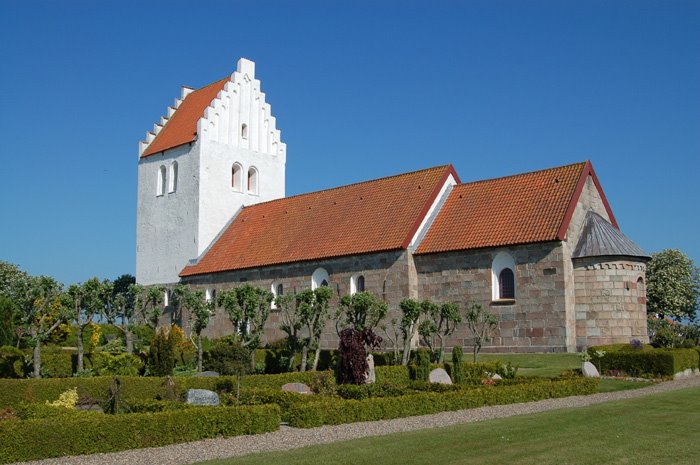
Tømmerby church/Tømmerby kirke, Vester Han herred, Thisted amt.


Tømmerby Church, Thy, 12 km west of Fjerritslev
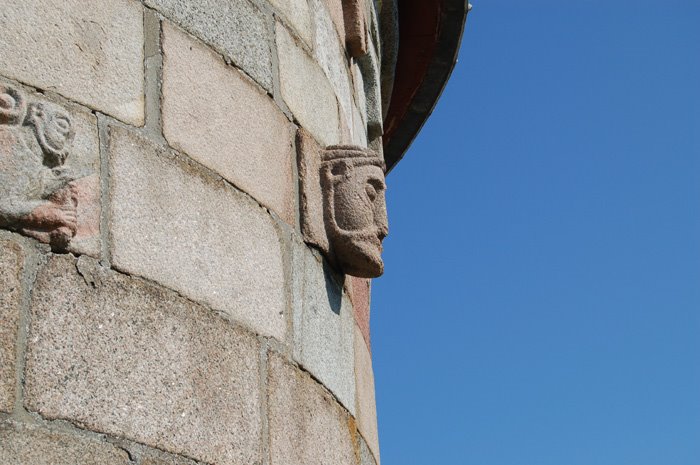

An aristocratic profile
Maybe the portrait of a founder
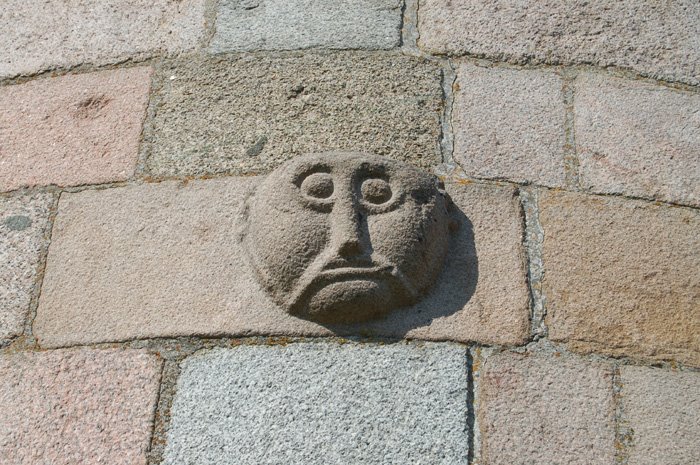
Another founder or a stone mason?


Lion eating a human head
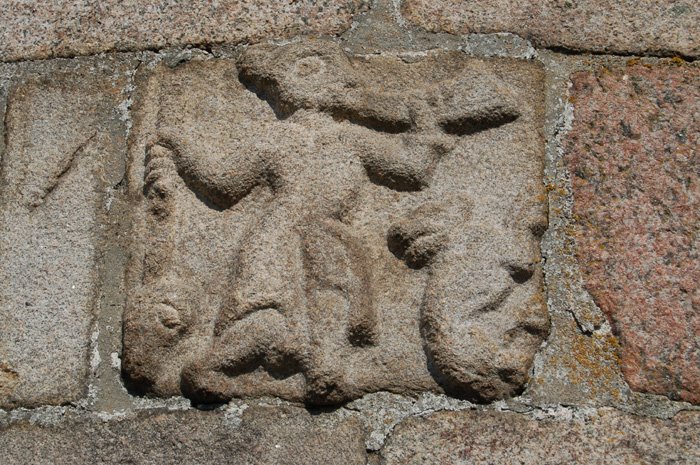

Hunter with dog


Deer chased by dog
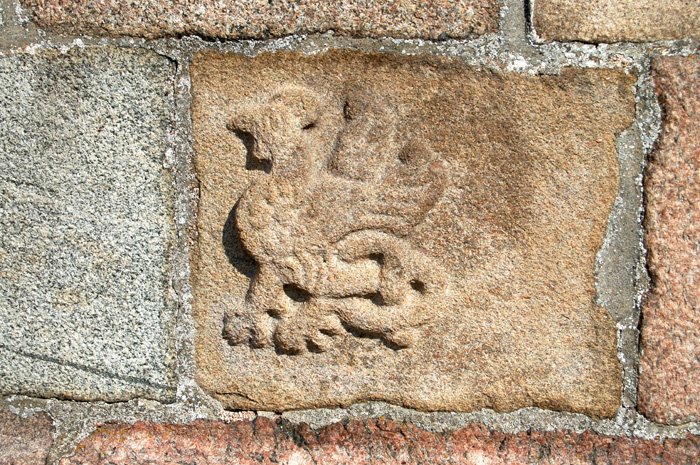

The basilisk
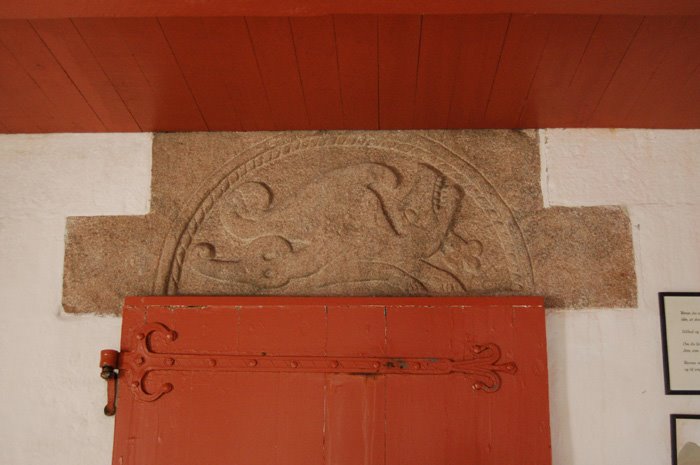

The dragon above the women's door


Tømmerby church yard on a peaceful sunny afternoon
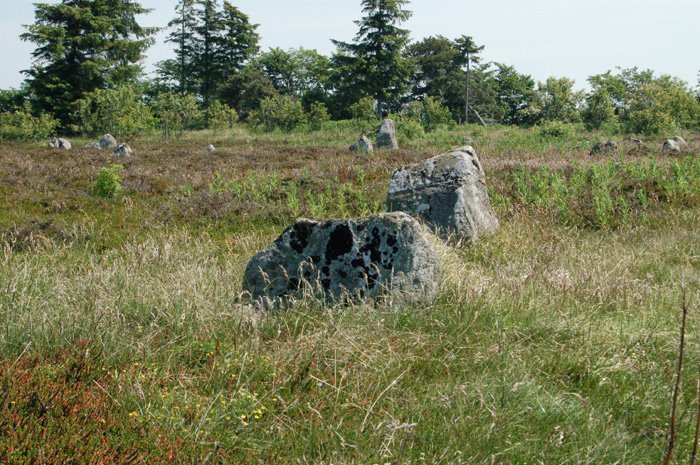

Højstrup Viking burial area

Tømmerby Church is situated high above and with a wonderful view over Vejlerne, the vast sanctuary of the birds by Limfjorden.The large Romanesque church in Thy was consecrated to the English Saint Botulf, (Danish Budolfi). It was probably built by an English building master, even though it lacks some of the details of similar churches in Vestervig in Thy and Vejby in North Zealand. The church was built in 1125 - 1175 , and the tower and porch are from ab. 1500. The Romanesque building is in granite ashlars. Three Romanesque windows are preserved. The still open north door has a tympanum with a relif of a dragon, the south door stands as an inside niche, outside it has almost dispappeared. Its tympanum with God's lamb is now in Lild church.

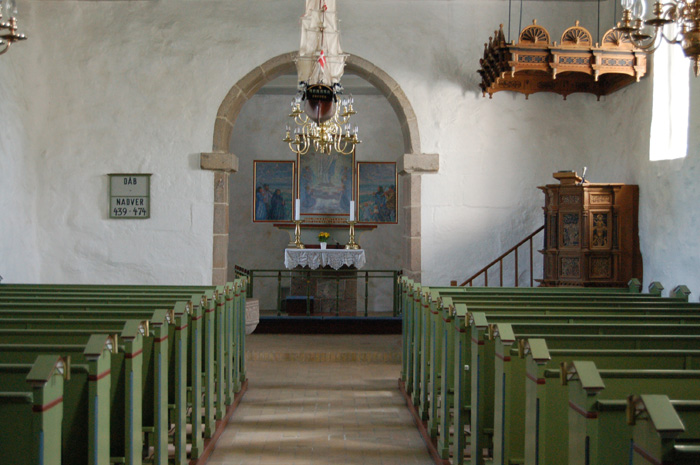
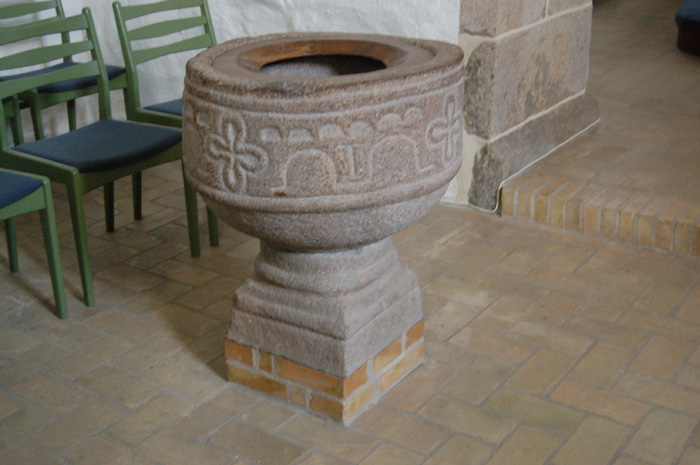
The Romanesque communion table is a rare type with a monolitplate upon four pillars. It contains a saint's grave of usual type. The altar piece is a rural work in high Renaissance from ab. 1600-10 and with the coat of arms of Peder Marsvin and Regitze Sophie Holgersdatter (Reedtz). Upon the communion table is a lead crucifix from a coffin. The Romanesque granite font has an interesting picture on the foot illustrating the story about the stork and the fox. The pulpit is in high Renaissance from the beginning of the 1600s and is a copy of the Thisted-pulpit with arcade friezes. Church bell from 1487.

The apse of the church is famous. 6 of the 200 well carved and finely coloured granite ashlars are equipped with splendid reliefs. Two male heads, which might be the portraits of the founders, are placed beside the richly profiled round arched window. The four other reliefs show a lion eating a human head, a hunter with his dog, a deer chased by a dog and a cock with a dragon's tail. The last mentioned picture belongs to the heathen superstition about the basilisk, a venomous, winged monster with a cock's feet and a dragon's body, which could only be fought down by a cockcrow and its own mirror image.

The heathen idolatry was still alive in the middle of the 1100s, which is also seen upon the north door's preserved tympanon with a foul fire-breathing dragon. Above the walled-in south door was a similar tympanon decorated with a relief of God's lamb, which now is placed in Lild Church north of Tømmerby.

Romanesque gravestones: 1) from ab. 1200, in a strange shape reminding about a Romanesque cross arm with a man's head and an outstretched right hand, which is explained as God's right hand 2) shaped as an octagonal ornamented pillar .

Names in the Middle Ages and 1600s:
Tømmerby (*1231 Tymberby, 1465 Tymmerby); Frøstrup (1470 Frøsdrop); Kærup (1470 Kyrdrop, 1483 Keerup); Højstrup (1408 Hogstorp, Høghstorp); Langvad (* 1231 Langwath);
Nr. Fuglsang (1552 Fogilsogen); Søndermølle ( 1552 Synderby Mølle, 1610 Sønder mølle); Dalsgård (1470 Dalsgordh); Rødbro ( 1573 Rødbrof); Mellemmølle (1610 Meldmølle).

In the parish were the farms: in 1483 Cwad gord, in 1552 Klødde- or Klodegaard, in 1664 Nobisgaard and Pilgaard plus the house Coldall. Nørmølle (in 1610 Nørmølle) was demolished in the 1800s. The farm Try (1688 Trygge) was mentioned up til present time.

Listed prehistorics: 14 hills of which the large Tornhøj, Kaphøj and Ålhøj (1638 Aalhøy). 3-4 km south of Tømmerby Church on the eastern side of Tømmerby Fjord is a big viking burial place at Højstrup with menhirs, stone ships and small burial mounds , scattered over a big area, an evidence of the close settlements in Thy in the Viking period and the early Middle Ages. The graves are mainly jordfæstelsesgrave (interment) with rather poor grave gifts, but there are also brandgrave (where the body was burnt before burial).
Demolished or destroyed:
48 hills,mainly upon the hillside at Højstrup and further north. A hill at Langvad contained a rich grave from early Bronze Age with a pålstav (war-axe), dagger and gilt bronze plates.

Source: Politikens bog om Danmarks kirker; Trap Danmark Thisted amt, 1961

photo 11June 2006: grethe bachmann

Sunday, July 05, 2009

Skyum church /Skyum kirke, Hassing herred, Thisted amt.


Skyum Church


Altar piece from 1638


Pulpit from the end of the 1500s


Ashlar with three animal figures.

Skyum church is a Romanesque ashlar building with nave and choir and a later added tower and porch. In the choir are two original windows, one in the altar-wall is seen as an inside niche, while the other in the north wall is still in use. The north door in the nave is bricked-up, the south door at the porch is still in use. A picture ashlar in the southern side-wall of the nave close to the gable has a relief image of three animals. Upon the northern side-wall above the bricked-up door is a carved male head. In the late Middle Ages was built a tower in front of the western gable in yellow monk bricks, the years upon the tower: 1752 and 1879 refer to repairs. The newer porch of an unknown age is built in monk bricks.

The inside of the church has beamed ceilings while the tower room has traces from a demolished cross-vault. The choir arch is high and slim and origins from the Romanesque period. Upon the walls of the church were since 1889 several times found rests of frescoes, but they were removed since they were impossible to restore. The Romanesque communion table in granite ashlars has a plate with a reliquary and a carved front panel from ab. 1600; the altar piece from 1638 is a naive carved work . A former altar decoration hangs upon the northern side-wall of the nave. A Romanesque granite font with a runic inscription, the male name Kir. Upon the east wall of the nave is a choir arch crucifix from ab. 1500. A pulpit from the end of the 1500s, in the archade fields are painted the Evangelists from the 1700s. At the west end of the nave is a gallery from the first half of the 1600s. A medieval church bell cast in 1497 and recast in 1885. During a renovation in 1939 the church had new windows in choir and nave and new beamed ceilings in the nave; the choir got a ceiling from the old beams from the nave.


Gravehill, Skyum Bjerge

Names in the Middle Ages:
Skyum (1555 Skyom,); Dybdal (*1467 Dybdal)

Listed prehistorics:
24 hills, of which a very pretty group of 7 hills on a listed area in Skyum Bjerge. in the southern part of the parish are the large hills Storehøj and Lillehøj, in the last mentioned are the rests of a stone grave.

Demolished or destroyed: 69 hills of which a large part were in Skyum Bjerge, one of the hills contained a grave from early Bronze Age with a dagger, a bøjlenål (jewelry) a gold ring etc.

Source: Trap Danmark, Thisted amt, 1961

photo August 2007: grethe bachmann

Monday, May 18, 2009

Hjardemål church /Hjardemål kirke, Hillerslev herred, Thisted amt.


Hjardemål Church , Thy
a few km south of the North Sea by Vigsø Bugt


Interior.


The Romanesque granite font is of Thybo-type.


A back entrance to the church yard.


A lake with water lilies in Hjardemål Dune Plantation.

The church has a Romanesque choir and nave, a Late Gothic western tower and a southern porch from the 1800s. The Romanesque building is in granite ashlars. Both doors are preserved , the south door is in use, the north door stands with an inside niche. The east window of the choir is an inside niche, while the round arched window to the north is well preserved. The nave has kept two original windows. In several places in the walls are ashlars with stone mason marks.
The unusual tall and heavy tower from about 1500 is built in monk bricks above re-used ashlars. The tower was a light house in its earlier days, but since the plantations grew up, it is invisible from the sea.

The church has beamed ceilings. The triumph arch has profiled 'kragsten'. The altar piece is made of three point arched fields with paintings from 1837. Above the altar piece is placed a square sounding board from ab. 1600. A romanesque granite font of thybo-type . A south German baptismal basin from ab. 1575. The pulpit is from ab. 1600. The sounding board above the pulpit is contemporary . The gallery in the western part of the church is from ab. 1600. The church bell from 1513.

Epitaph ab. 1650 on Chr. Nielsen Morsing, + 1673, a joinery in rural Renaissance. Gravestone 1) Lauridtz Jensen Koch, + 1691 and wife, 2) parish priest Peder Nielsen Sengeløs, + 1699.

Names in the Middle Ages and the 1600s:
Hjaremål/Hjardemål (* 1436 Hiarmull, 1477 Hormol, 1505 Hiermall, 1664 Hiarmall);
Kåse (*1435 Kaasse); Tved (1600 Tuedt); Skiverklit (1470 Skyrdklitte, Skywrklitte, 1483 Skørclith); Blovsgaarde (1602 Blagsgaardt, 1664 Blochsgaard); Rimmegaard (1664 Rimergaard, 1688 Paa Remmen); Rovergaard ( 1638 Rovad); Oddersbøl (1600 Odersbøll); Madsbøl (1477 Marssbol); Langhov( 1603 Langschou, 1664 Paa Haw).

Oddersbøl ( in 1686 belonging to Vesløsgaard), was owned after 1686 by Laurids Koch (+1691) and then his widow Anne Sørensdatter Guldager, whose daughter Anne brought it to her husband Casper Preetzmann. In 1752 it belonged to his son Erik Zacharias Preetzmann (+1772), whose widow Margrethe Hesseldahl kept it until her death in 1796.

Esper Hvas of Tved (the family Hvas of Skjortholt) is mentioned in 1568.

In 1477 Per Nielsen of Langvad had estate Marssbol in pawn for 16 mark dansk by Otto Stampe (the family Stampe of Klarupgård) and Ingerd Lauridsdattter (maybe O. Stampe's wife), whose rightful inheritance it was. In 1505 Otto Stampe's son Mogens Stampe sold "Morsbooel" to Margrethe Turesdatter (Bjelke) of Ågård.

In 1472 væbner Michel Terkildsen of Korssze is mentioned.

The house Voldum is the rest of a village by the same name (1508 Vollom) In the parish is in 1552 and later mentioned the farm Medelklit, ab. 1600 the farms Ved Kæret (1600 Vid Kieridt) and Fladskæret (1603 Fladtzkeridt), in 1664 the farms Wed Blød and Lille Odersbøl.

Listed prehistorics:
Two hills of which one at Tved is large. Demolished hills not noted, but two Bronze Age grave findings are known, both with a dagger and a pålstav (axe-type). At Korsø were found several graves, built in limestone, with graves from Roman Iron Age.

The parish - being only a few km from the North Sea - has suffered extremely from sand drift. But the large Hjardemål Dune Plantation is not only sand. There are several small lakes.

Source: Trap Danmark, Thisted amt, 1961

photo 15 June 2006: grethe bachmann

Sunday, May 17, 2009

Hjortdal church /Hjortdal kirke, Vester Han herred, Thisted amt.


Hjortdal church, Thy, 8 km northeast of Fjerritslev


Interior


Romanesque granite font


The desolate placed Hjortdal church from the 1100s has a Romanesque choir and nave, a low late Gothic tower to the west and a porch from 1586 to the north. The Romanesque part is built in granite ashlars. The north door is still in use ,while the south door shows vague traces in the outer wall. In the eastern wall of the choir is a round arched monolit cover stone in its original place, while the window itself is walled-in. In the nave are no original windows.

The inside of the church has beamed ceilings and the original choir arch is preserved. The late Gothic tower is built in re-used ashlars and raw boulder. Its small tower arch is almost circular and the room has traces of a disappeared of not finished vault. The upper sections of the tower was demolished in ab. 1807 and it is now only a little higher than the nave.

The Romanesque communion table is in granite ashlars. The altar piece has sections from a piece from 1700, but with new wings and a painting from 1942. An earlier altar painting from 1856 was painted an given by fru Lucie Ingemann. A Romanesque granite font with Romanesque granite font has cruciflowers and arch friezes upon the basin. A south German baptismal basin from ab. 1575, given in 1695 by Sidsel Mickelsdatter. A pulpit from 1592, a Aalborg-joinery with flatcarved fields, a gift from Palle Griis, the owner of Slettegård. The sounding board above the pulpit it is from 1598, made by another cabinet-maker, restored in 1959. A pengeblok (iron bound oak post) from 1777. A door wing from 16-1700s is now in the north door of the tower. A church bell from ab. 1450-75 by PLP.

Gravestones: 1) Romanesque granite, no inscriptions, with cross and other figures, probably a gable stone; 2) parish priest Rasmus Lind, + 1757 ; 3) Chr. Brix, + 1807; 4) Mette Cathrine Mørup, + 1838; 5) Søren Mørup, + 1849.

Names in the Middle Ages and 1600s:
Hjortdal (* 1386 Vester Hiertells, 1458 Hiortils, 1470 Hiortels)
Vester Svenstrup (1466 Wester Swenstrvp); Sanden (1688 Paa Sand); Slettegård (1450 Slætæ); Nørtorup (1466 Torop gord, 1688 Nør Torup) ; Fasmali (1638 Faszmerlie, 1664 Fosmelie); Hedegård (1638 Hædegaardt).

Slettegård, was earlier named Slette, belonged for a long period to the lavadelsslægten (lesser nibility) Griis. The earliest known owner was Anders Griis in Slette in 1450-70, his son Palle Griis is mentioned in 1494 , he must have been deceased in ab. 1530, for two years later was written: " Here lived some years ago a peasant in Hanherred, named Palle Griis...". His four sons: Anders, Christoffer, Bagge (+ 1534 in an attempt to kill Skipper Clement) and Niels Griis owned Slette together. Niels Griis died before 1556 , since his widow Bodil Svendsdatter Orning was the owner of S. at that time. The son Palle Griis (+ 1618) inherited S. and it went on to his son Bagge Griis, who was the owner in 1608 and 1633. He died one or two years later. His sister Anne Griis brought in 1630 a part of S. to her husband Vogn Krag (Kid) who still lived there in 1651. Still in the 1700s Slette/Slettegård belonged to the family Griis and their descendants. Slettegård was very reduced in 1943 where it was sold to P. Kornum.

In Vester Svenstrup was a main farm Nørgård (*1480 Nørregardh) or Svenstrup, which in 1519 belonged to Christen Krag (of the family Kid), in 1538-45 to his son Mikkel Kid or Krag (+ before 1557) whose heirs owned it in 1568. Mikkel K.'s son's son (?) Vogn Krag was the owner of S. in 1623-34, and his brother Poul Krag (+1641) sold in 1632 his part of Nørgård in Vester Svenstrup to Christoffer Kaas (+ ab. 1656) ( of the family with a sparre (chevron) in their coat of arms.

Another main farm, Nørgård in Torup, later named Nørtorup, must have belonged to Palle Griis of Slette (+ ab. 1530) and after him to his three sons: Bagge, Anders and Niels Griis. Bagge Griis' daughter Karen was married to Munk Elbæk (of the family Vognsen of Stenshede) whose heirs in 1568 owned 1/3 of N, and their son Palle Munk is mentioned in 1580 as heir of N. Anders Griis' son Vogn Griis owned in 1568 (together with his siblings) 2/3 of N., and his sons Anders and Jakob Griis (+ 1651) lived her. From 1699 various owners.

In Vester Svenstrup is mentioned the farm Præstbjerg (1552 Prestbierig) in the 1500s and 1600s. At Nørtorup was a farm Hellegård, mentioned in 1688. The houses , 1664 Wildboren and 1688 Fischer Huuset were built in the area by Slette. The mill Slettemølle was probably named Søndermølle in the Middle Ages.

Listed prehistorics: A long hill south of Hedegård and 51 hills, of which several are large: Torshøj west of the church, Duehøj at Nørtorup, Gravenhøj in Fosdal plantation and two hills, i.e. Knaghøj in Svinkløv plantation. A bautasten (menhir) Den grå sten ( the Grey Stone), which once belonged to a row of stones by a hill in a group of 6 hills south west of Vester Svenstrup. Demolished or destroyed: 57 hills, which mainly were on the hillsides to the south and the east.

Sct. Olufs Kilde ( sacred spring) at the foot of a tall hill at Svinkløv was used as a healing spring until ab. 1890.

In a letter of 1555 it was decided that Hjortdal church had to be demolished, the parish people from Hjortdal and Hedegård then had to go to other churches, but in 1558 the decision was given up because of the intercession from the parish.

The parish of Hjortdal was almost annihilated by a violent sand drift which ravaged the area from the 1600s up to the 1800s. The area around the church yard is still marked by the sand drift from then.

The church is situated in the outskirts of Svinkløv plantation together with the manor Slettegård in a beautiful cultural environment. An old gravel road leads from the church to Slette Å and then upon an old characteristic ashlar bridge across Slette Å down to the manor.

Hjortdal was situated on one of the Middle Age's road connections from the Thing and bishopric in Viborg to the powerful Børglum Kloster. From the crossing by Aggersborg people rode via Hjortdal and Lerup church, where a Holy spring once was - and through the beautiful Fosdalen down to the coast, where the beach made a safe passage to the north.

Source: Trap Danmark, Thisted amt.


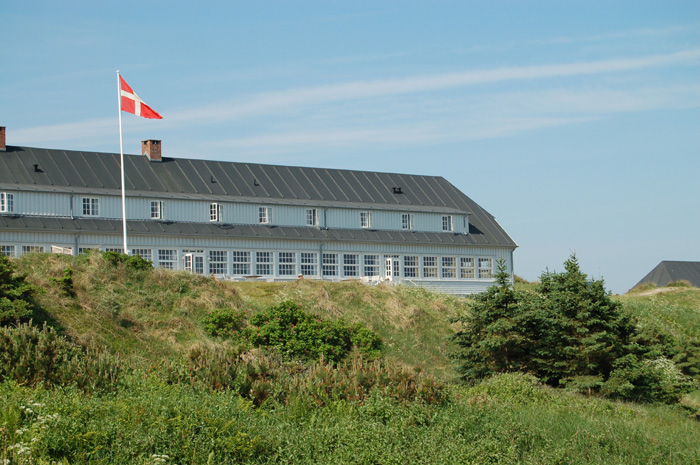
Svinkløv Badehotel and the beach in June.


photo 13 June 2006: grethe bachmann

Tuesday, March 03, 2009

Astrup church /Astrup kirke, Ning herred, Århus amt.


Astrup kirke, ab. 15 km south of Århus

The church has a Romanesque choir and nave in granite ashlars, while the bottom of the tower to the west is Late Gothic, the porch in monk bricks to the south is from the reformation period, the sacristi from the 1700s and the tower from 1780. The south portal is preserved and in use. It has a tympanum with a human figure between lions and upon the side stones of the door are upright lions. The north door is walled like three Romanesque windows. In the Late Gothic period was built a tower of the same width as the nave but only the bottom is preserved. It is not known when the Late Gothic tower was broken down, but in 1780 a new and smaller tower of bricks was built. Upon its pyramid roof is a funny weathercock of wrought iron with the year 1782.

In Astrup church are frescoes from the 1500s. Upon one vault of the nave is a minuskel-inscription telling that in 1511 this inscription was made in the time of the parish priest Per Nielsen. At the choir arch is a versal-inscription below an emblem "Henricus Stephan Horsnetianus 73 ( probably 1573). The altarpiece is a painting from the late 1800s. The granite font is from present time like the pulpit. The bell from 1698 was cast by Peter Christoffer Geiger, given by admiral Janus Rodsteen.

Astrup vicarage was built in 1777.


Søren Munk (Vinranke-munk) is mentioned 1543 in Drammelstrup. Drammelstrupgård was from the Crown sold to Mogens Friis.
Erik Bruun bought in 1316 estate in Løjenkjær by exchange with Ring Kloster.

There are no listed prehistorics in the parish, but there were 3 hills. 

Names in the Middle Ages:
Astrup (1544 Astrup); Ask (1499 Ask, 1560 Aske); Bøgeskov (1580 Bøgiskouff); Løjenkær (1316 Lotenkier, 1580 Loienkier, Løyenkier); Drammelstrup (1479 Dramestropp, 1499 Dramelstrup); Rasborg (1610 Radtzborre). 

Source. Trap Danmark, Århus Amt, 1963.

photo Astrup 2004: grethe bachmann
Monday, February 09, 2009

Framlev church / Framlev kirke, Framlev herred, Århus amt.


Framlev Church, 10 km west of Århus

The large Romanesque church in Framlev was built in the 1100s. The choir and the nave are travertine and raw granite. The eastern gable of the choir has three large round-arched blind archades and above in the roof gable is placed a limestone ashlar portraying the crucified Christ above an animal head. Two Romanesque windows are bricked-up, while four others are in use. The north door is bricked-up, while the south door has a tympanum with a lion figure. The tower with a pyramid roof and the porch are both in monk bricks and added in the late Middle Ages. Except for the tower the church is white-washed.


In the late Middle Ages the choir was equipped with an octagonal vault without wall curves. Two Romanesque frescoes are preserved - a decoration in the north window of the choir and a Maria-image from ab. 1250. An oak plank with a round-arched window-opening from an earlier wooden church is now at the National Museum. The communion table in monk bricks is covered in a Renaissance panel. The altar piece is from 1590 with an new painting and upon the communion table is a large medieval lectern in oak with carved Gothic ornaments, and upon the lectern a bible from 1633 , equipped with a new binding. The Romanesque granite font has double lions. A carved font sounding board from 1663 and an akvamanile from ab. 1350 are now at the National Museum. The pulpit with a sounding board is Renaissance from 1602 with an entrance panel from 1604 made by Morten Snedker and with original paintings, fx. the coat of arms of Arild Huitfeldt. A late Gothic parish clerk chair with the coat of arms of Niels Clausen Skade. Closed pews with triangle gables and with the year 1654. In the porch is walled two Romanesque gravestones with cross and other figures. Besides gravestones from the 1600s.


Chicken yard with both hens and cattle opposite the church.


Jes Bonde bought estate in Framlev, exchanged with Ribe Chapter and sold it before 1341 to hr. Ove Hase.

Rural dean Jens in Århus endowed 1313 among others a farm in Lillering for an altar in Århus Cathedral.

Estate in Labing was exchanged by hr. Stig Andersen Hvide 1336 to the chapter in Århus.

Labinggård was after having belonged to Palle Bryning and hr. Markvard Rostrup the object of an exchange and belonged in 1484 to Erik Ottesen Rosenkrantz; in 1514 it was owned by Tvilum Kloster, which had pawned it to bishop Niels Clausen Skade of Århus.

Labing mølle is mentioned in 1385; in 1587 it was endowed to Christen Munk of Gjessinggård, but it belonged in 1613 to Skanderborg Slot, later to Lyngbygård.

Hørslevgård was by Albert Skeel exchanged to the Crown in 1541.

Vorgård was sold by Erik Hvas (of Ormstrup) 1475; still in the 1600s there was only one farm. The esquire Thomas Jensen of Snåstrup is mentioned in 1460.

In the parish are two sacred wells, Hulken between Hørslevbol and Skovby, now an ordinary watering place, and Sct. Thomas kilde south of Framlev; the last is said having been used in the 1800s.

Højbygård is the rest of a village Højby (1398 Høyby), which is mentioned as desolate in 1683. In the parish is also mentioned a farm Kirkegård (1492 Kirchygarden); it had burnt down in 1683.

Listed prehistorics: A dolmen chamber without cover stone west in the parish and 3 hills, of which one at Labing is large.
Demolished or destroyed: two dolmens and 34 hills.

At Snåstrup have been found a burial site from Roman Iron Age with clay pots, bronze buckles, pearls etc.

Names in the Middle Ages: Framlev (1310 Framleff, 1341 Framløf); Labing (1336 Labum, 1480 Labing) ; Hørslev (1480 Hørsløff); Hørslevbol (1541 Bolen, Bolem, 1573 Hørsløffbuoll (e)); Lillering (1263 Lille Rings marck, 1313 Litlærind); Snåstrup (1398 Snalstrup, 1460 Snalstrvp); Vorgårde (1475 Wordgaardt); Labinggård (1418 Labinggaard); Hørslevgård (1480 Hørsløffgaard). 


Source: Trap Danmark, Århus amt, 1963

photo 2004 Framlev:grethe bachmann

Elev church /Elev kirke, Vester Lisbjerg herred, Århus amt.


Elev Church, 10 km north of Århus

The small building in ashlar stones has a choir and nave from the Romanesque period , built in the 11100s. The porch in monk bricks was added later in the Middle Ages. The west wall of the porch is in line with the nave and the heavy walls in monk bricks might suggest that a tower was planned here. The whole church is white-washed except the choir gable. The south portal of the porch shows a tympanum with the crucified and victorious Christ, portrayed like a strong Viking chief, under his arms are four persons , two on each side. One can be identified as the apostle Peter with the key. Rests of another tympanum with pieces of an angel is walled in the western wall of the porch. At the entrance to the porch are a couple of bases from a Romanesque pillar portal, probably from the missing north portal. The bell hangs in an opening in the western gable of the nave.


The church room itself is small, the nave is only 54 square meter. The Romanesque choir arch with kragsten (oblong relief stones) is preserved and in the late Middle Ages the choir had a cross vault. The triptychon is Renaissance from the 1600s. In the middle field is a new painting. The simple Romanesque granite font is placed upon a square foot. The pulpit is a cabinetmaker's work from the end of the 1500s with simple panels. The entrance to the pulpit is from the same period as the triptychon. The sounding board above the pulpit is from 1683 and below it hovers a Holy Spirit Dove. In a renovation 1998 the pews from the 1600s were painted in olive and grey- blue colours. In the eastern wall of the porch is placed a gravestone from early Middle Age with a cross stick and bird images.

There are no listed prehistorics in the parish but there were 3 hills, like Stabshøj where were found Bronze Age pieces.

At Elev were examined several claypot graves from early Roman period.

Names in the Middle Ages:
1431 Edeløffue; 1439 Ætheløff


Source: Trap Danmark, Århus Amt , 1963. 

photo Elev 2004: grethe bachmann
Thursday, February 05, 2009

Elsted church Elsted kirke, Vester Lisbjerg herred, Århus amt.


Elsted Church, 10 km north or Århus

The sun dial

Elsted Church has a choir and nave from the Romanesque period built partly in granite ashlars, partly in cleaved granite boulders. The church has white-washed walls and a tiled roof. The tower and porch are late Gothic in monk bricks. The tower is the narrow East Jutland-type, originally open in front. Later the opening was walled and in the 1700s a portal was added. In the gable of the porch is a sun dial with the year 1727.

The high-placed Romanesque windows are brought to light as niches on the north side of the nave and a Romanesque window is vaguely seen in the north and east wall of the choir. Both doors in the nave are preserved, the north door is walled, while the south door still functions with a round-arched opening and relief stones.

The church has a beamed ceiling, while the choir has a Gothic cross vault. The tall choir arch is preserved from Romanesque period with kragbånd. (oblong relief stone-band). Upon the vault of the choir was in 1944 brought to light a rib-decoration from  the late Gothich period - and upon triumfvæggen (wall between church and altar) was found a small bit of a Romanesque frescoe. A Gothic cupboard with old furniture and grating is framed below the walled window in the north side of the choir. It was possibly once a monstrans cupboard .The Romanesque granite font has lion figures - the simply decorated pulpit is from 1636. There are several large gravestones, partly in the porch and partly in the nave.


Kirkegaden, the village street leads to Elsted church

New Art in Elsted kirke:
Jens Urup, who has created much art in Danish churches, has decorated the ceiling of the nave as a wonderful violet evening sky. The beautiful new altar wall is created by Bent Exner, the great gold- and silversmith, who also has created unique church art. Bent Exner died in 2006.
 

Names in the Middle ages: Elsted (1374 Elstedt, 1439 Æstet, Ælstethæ).

Øm Kloster exchanged 1490 a farm in Elsted with the Crown.

The now disappeared Såstrupgård was the last rest of a village Såstrup (1425 Sastrop). A bol (a small farm) Fornebol (1490 Forneboer, Fæderneboel) is mentioned in the parish in 1490.


Listed prehistorics: two hills, of which the large Blindemandshøj. (Blind Man's Hill).
Destroyed: two hills.

Claypot graves from the Roman period have been found at several sites in Elsted parish.


source: Trap Danmark, Århus amt, 1963.


photo Elsted 2003: grethe bachmann

Wednesday, February 04, 2009

Borris Church, Special section of burial place
The Vilstrup Family(for Wendy)
See article about Borris Church below.


photo 2008: gb and
stig bachmann nielsen
Naturplan foto

Tuesday, February 03, 2009

Hoven church / Hoven kirke, Nørre Horne herred, Ringkøbing amt.


Hoven church, near Ringkøbing

The small church has a beautiful place by Omme Å (river). It has a Romanesque choir and nave while the porch is later. The tower is from 1961 - it replaced a a ridge turret from 1874. The church has gone through some thorough main restorations, where the walls were enlarged and new windows were placed.

The building materials are granite ashlars in the nave, raw boulder and ashlars in the choir. The south door is in use, while the north door with a cover stone is walled-in. Vague traces of two original windows.

The inside of the church has beamed ceilings. The communion table is walled and washed and has a Late Gothic triptychon from the end of the 1400s. The altar chalice is from about 1600. The Renaissance candle sticks are from the beginning of the 1600s. The Romanesque granite font is West Jutland type with a walled bottom. The pulpit is from ab. 1600 but much changed, probably in 1875. At Herning Museum are the reliefs from the big fields. The church bell is from the second half of the 1200s.


Omme Å

Source: Trap Danmark, Ringkøbing amt
photo 2003: grethe bachmann