Showing posts with label sand drift. Show all posts

Thursday, April 11, 2013

Hune church / Hune kirke, Hvetbo herred, Hjørring amt.


Hune church, ab. 22 km southwest of Hjørring.


Hune parish, Hvetbo herred, Hjørring amt. 

Hune church is inaugurated to Vor Frue (Our Lady). It has a nave, a choir with apse, a west tower and a porch to the south.The nave, choir and apse are Romanesque and built in granite ashlars upon a bevelled plinth, the apse has a double plinth with profiles. The southern walls have newer windows, but the north side has traces after the original, now bricked-up windows. The north, square door is bricked-up after 1642, the south door is still in use. In the north wall of the choir is a low-placed, small, now bricked-up wall opening, which might have been a leprosy window. The tower is mostly built in bricks in the Gothic period, in same broadth as the nave and straight gables west-east. A staircase on the west wall of the tower. The upper section of the tower was later re-walled  and made lower. The overvaulted tower room, which has a pointed arch towards the nave, is now used as a burial chapel and is separated from the nave by a new brick wall. Probably at the same time as the building of the tower the church was overvaulted, and the rather high, vaulted porch was added. The original Romanesque triumph arch divides the three vault-bays of the nave (rib-vaults) from the one vault of the choir. The apse, which original vault is rebuilt in the Gothic period, is a half rib vault is now separated from the choir by a barrier wall and is used as a sacristy. The church was restored in 1937.

Interior:
The communion table is granite. The altarpiece from 1850 with a painting signed Vige 1909. Late Gothic candelabres, chalice and dish from the 1600s. An oblat box in silver, given by Jens Gleerup of Lundergaård in 1760 (with inscription). A Romanesque font with a rope stick. A late Gothic Maria figure is set up in the nave. A late Gothic Christ figure was given to Vendsyssels historiske Museum in 1932. A grey-painted pulpit from the late 1700s. Upon the north wall of the nave hangs the original altarpicture. A late medieval bell in the tower without inscription.

News since 1960: The late Gothic Christ figure which was given to Vendsyssel Museum in 1932 has now returned to Hune church and was in 1992 placed upon the wall above the altar table. 


Memorials: 

Epitaph in marble in the choir for the priest Hans Winde and wife, (both + 1741), set up by Laurids Winde 1772. Under the epitaph is inserted an oak plate, set up in 1774 by the parish clerks Christen and Jens Winde. In the choir a gravestone for ship-trader Svend Bondrup (+ 1789) and wife. A Romanesque gravestone with a carved cross is inserted in the wall of the porch. Another lies south of the nave.

Runestone:
In the tower room stands a runestone from the Viking period, which inscription is: "Hove, Thorkil og Thorbjørn satte deres fader Rumulf den rådsnildes sten." ("Hove, Thorkil and Thorbjørn raised this stone for their father Rumulf the Clever." )


Upon a farm in Hunetorp lived in the 1600s some nobles, like before 1626 Vogn Krag (Kid) (+ earliest 1657) of Nørgård in Svenstrup (Hjortdal parish), m. to Anne Pallesdatter Griis of Slettegård (+ earliest 1653); ab. 1656 lived in H. fru Maren Henriksdatter Krag (+ latest 1669), widow after Bagge Griis of Slette (+ ab. 1635), who was the brother of above mentioned fru Anne. She married since Niels Fredberg of Fredbjerggård and Trinderup (Onsild herred) ( + earliest 1652). Her daughter (of 1 marriage) Kirsten Baggesdatter Griis was m. to John Finlasson Scott (+ 1713), who lived at the farm in H. and probably bought out his co-heirs in ab. 1664. In 1679  they moved from H. , probably to Gundestrup in Skræm parish, their son Jørgen or (Johan) Scott( + 1733), sold in 1727 a farm in H. where he probably had resided.


landscape , Blokhus, photo 2011: grethe bachmann
From disappeared farms of Hune parish: Maegård was in 1611 destroyed by the sand drift, Bjørnsgård even sooner, but it is still mentioned in 1679. Klitgård was the old vicarage of the parish, but already in 1571 much dilapidated by the sand drift; in 1690 it was only a house, the name exists still in 1714. Trudsholm is in 1611 mentioned as a farm, in 1662 as a lesser house, it is probably identical with Storkborg
 

Hune kro (inn) was established in 1858,but was in 1892 moved to Pandrup.

Blokhus Mølle ( a weather mill )was mentioned already in 1688. At Blokhus bæk (brook) was until ab. 1885 a small valkemølle (fulling cloth).  

Blokhus 2011, photo: grethe bachmann
At Pirupshvarre was in the beginning of the 1800s upon Lien a guard shack and an alarm pole,  from where was lookout for hostile ships.

In Hunetorp was in 1958 by National Museum brought to light some farm sites from the Renaissance.

Klitgårds badehotel is not a typical representative of the North Jutland farms, but it stands with solid timbered outbuildings, of which the eastern originally was a living house and the western contained store rooms as a memory about the ship-traders' farms in the 1700s and 1800s in the coast cities of Vendsyssel.

In Hune parish were besides the above mentioned farms Bjørnsgård, Trudsholm, (1662 Rruds Holmen), Klitgård (1688 Klit Gaard) and Maegård (1688 Morgaard, 1722 Maagaard) also the farm Løkkegård (1665 Lyckegaard) and the houses mentioned in 1662: Schallebore and Broerbech.    


Blokhus, tourist shop, photo 2011: grethe bachmann
In Aalborg's lensregnskab (the vasalry's account of Aalborg) from the beginning of the 1600s is mentioned "Blokhuset", probably established ab. 1600 as a warehouse for the beginning skudehandel (barge trade) with Norway. It grew quickly into a small town, which in the 1700s was as profitable as Løkken.

The Hune parish was in its time very fertile and well populated with "7 farms resided by aristocracy", but the sand drift had harrassed the parish already 300 years ago, in 1582 is said that the parish "mestendels var ødelagt af sandflugt" ( mostly was destroyed by sand drift). 

Southwest of the church was until ab. 1870 a square stone setting called Tingstedet ,  which  might have been the original Thing place of the parish.

Listed prehistorics: 6 hills, among these are 4 rather large, like Storhøj at Ribergårde. 
Demolished or destroyed: two long dolmens and 39 hills, almost all in the northern part of the parish. At a large stone were found 6 uncut, thicknecked flintaxes, and at Stenmark were partly found a collected find of a spear  head and a pålstav (little axe), partly several early Roman period's stone graves.

Memorial for the author Thomas Olesen Løkken 1957 at the road between Hune and Blokhus.


Names from the Middle Ages and 1600s:  Hune kirke (1400 Hone); Blokhus (1688 Bloch Huusene); Hunetorp (1340 Houetorp/Honetorp); Pirup (1356 Pipetorp, 1471 Pirop); Pirupshvarre (1662 Huarit); Engesgård (1662 Engisgaard); Gl. Ulvholm (1610 Wldholm); Holmegård (1688 paa Holmen); Hedegård (1662 Heegaard); Brogård (1626 Sønderbroegaard, Nørbroegaard); Buj (1463 Nør-, Synder Buye, 1466 Kierling Buye, 1662 Bui); Hvarregård (1610 Huarregaard); Brogård (1638 Brogaard); Krattet (1638 Krattid).


 Source: Trap Danmark, Hjørring amt, 1960.

photo Hune church, borrowed from Google earth 2013, gb. 
photo Blokhus and landscape 2011: grethe bachmann 


Wednesday, October 17, 2012

Sæby church/ Sæby kirke, Harre herred, Viborg amt.


The pretty little church in Sæby lies upon a hillside east of Glyngøre and with a view to Grynderup sø (the new lake). It has a Romanesque choir and nave and a new porch to the south. The original building-sections are in granite ashlars upon a bevel plinth. Both doors are preserved, the north door is bricked-up. Several Romanesque windows were re-opened in a restoration 1951-52. The finely proportioned choir-arch has profiled kragsten. The inside of the church has a flat, beamed ceiling. The porch in yellow bricks was rebuilt in 1951. The church has blank walls and a tiled roof. At the east gable is a timbered bell-tower.


dike and old trees
two bells in timbered bell-tower.


view to Grynderup sø
The front of the communion table is a joinery in Renaissance style with paintings from 1656, the table itself was re-newed in 1951. In the carved Renaissance altarpiece were in 1952 inserted paintings by Ingolf Røjbæk. An old Last Supper-painting hangs in the nave. Furthermore is in the church kept a section of altar paintings from 1854. The altar chalice was given by vasal at Skivehus, Ebbe Jacobsen Ulfeldt and fru Mette Grubbe 1650. New altar candelabres. A Romanesque granite font in West Jutland type (thybo). A new baptismal dish. A pulpit in pine-wood with infills of folding work and carved year 1593, decorations from 1656, repaired 1952.  New pews. Two early Gothic figures are now kept in the National Museum. A late Gothic bell with unreadable signs.

In the parish was some sand drift which according to Pont. Atlas began ab. 1747 , but has stopped long ago.

While digging peat in a bog at Grynderyp were in 1842 found 21 coins, of which: 13 socalled brakteats from Hedeby (Haithabu) from the 900s and 7 Arab dirhemes from 892-907;  besides a small silver bar and 18 pearls in rock crystal, glass and alike.

Listed prehistorics: 4 hills
Destroyed or demolished: 27 hills.

Two kitchen middens in the northern part of the parish. In a moor at Grynderup were found two necklaces from Bronze Age.   


Names from the Middle Ages:
Sæby (1402 Sæby); Grynderup (1424 Grundrupp, 1468 Gryndorp); Holmgårde (1474 Hollom gordt); Snabe (1547 Svob, 1683 Snabe); Kærgård (1524 Kiergardt); Bækkegård (after 1448 Bæksgaard, 1684 Gløngbechgaard).

Source: Trap Danmark, Viborg amt, 1962.


photo: Sæby kirke september 2012: grethe bachmann

Thursday, July 23, 2009

Skallerup church / Skallerup kirke, Vennebjerg herred, Hjørring amt


Skallerup Church, ab. 10 km west of Hjørring
Skallerup sogn, Vennebjerg herred, Hjørring amt.

Chessboard pattern

Skallerup church is situated a few km from the north sea behind the inland dunes. North of the church was the village Skallerup, which has disappeared like many other villages in the area caused by the sand drift. The church has a Romanesque choir and nave, a western tower, sacristi and porch from the late Gothic period. The Romanesque building is in granite ashlars, the north door is walled-in while the extended south door is still in use. Two round-curved monolit-cover stones from two original windows are placed in the south wall of the choir. A chessboard pattern in the wall of the nave.The round choir arch inside is preserved. The cross vaulted sacristi in monk bricks and ashlars was added in the late Gothic period and at almost at the same time the tower was built to the west. Its bottom room opens to the nave in a pointed arch.The church bells han g in a bell frame. the whole building was restored in 1942. On several occassions , latest in 1910 and 1939, were found badly preserved late Gothic frescoes which were covered in white-wash again.

The communion table in ashlars has a niche for hiding and a reliquary in the top plate. The altar piece is a Lutheranian triptychon from 1600 is placed by Hans Rosenberg like the pulpit from 1605, both probaby from Niels Ibsen's workshop. A half-circular basin upon a round foot. (baptismal font). A fine late Gothic choir arch crucifix, repaired in 1914. A pretty late Gothic cupboard from 1529 with a minuskel-inscription stands in the choir, where is also a large painted anetavle (genealogical table) with 62 coat of arms for the ancestors of Hans Wulf Unger of Villerup and his wife Berete Kaas, who with other members of the family were buried under the choir. Some coffin plates are preserved from the 1600s and 1700s. At the church yard a Romanesque grave stone with a curved top. Bell 1) 1562 2) 1789 from Bakker, Rotterdam, saved in 1875 from the wreck "The Crescent".


Dunes with an access to the sea.

Names in the Middle Ages and 1600s:
Skallerup (* 1413 Skelrum, 1433 Scheldorp); Sønderlev (1325 Synderlyugh); Nørum (*1471 Nørrum); Villerup (*1436 Willerup); Størup (1484 Størop); Hunderup (1355 Hundorp); Klitgård (1662 Klitten).

A Petrus Niclessun de Synderlyngh is mentioned in 1325. In 1438 rigsråd Jakob Nielsen Basse of Nielstrup (Sunds herred)(+ earliest 1439), conveyed Synderleffgaard and more estate in Vennebjerg herred and Jerslev herred to bishop Gert (Gerhardt) of Børglum )(+1452). In 1534 came Sønderlev by law to Børglum kloster estate.
Villerup was already a main farm in the late Middle Ages, and according to tradition it belonged to hr. Stig Pedersen (Skovgaard), who lived in the beginning of the 1300s and was a høvedsmand for Vendelbo ships. From him the farm came to his son hr. Niels Stigsen Skovgaard, whose daughter Kirsten Nielsdatter Skovgaard ( died as a widow earliest 1361) by marriage brought Villerup and Linderumgård to her husband Otte Eriksen Lunov (+ latest 1361). One of their daughters Nille Ottesdatter Lunov was married to Jens Havgaard, who thus got a part of V. ; another daughter seems to have married Henrik Clausen Smalsted (+ earliest 1435) whose son Otte Henriksen smalsted in 1436 wrote himself of Villerup. Various owners: Smalsted, Friis, Kaas (Sparre-K.), Unger, Giedde, etc.

The farms Knolde and Størup belonged in the end of the 1400s to some noble siblings of the family Palnesen, Kalli Palnesen, who already in 1469 lived in K.; the væbner Niels Palnesen (+ latest 1487), who in 1484 wrote himself of K. and then pawned Størup to Økloster; Mogens Palnesen in K. who in 1480 sold his part of Knolde and Knolde estate to Vil Thomesen Galskyt of Odden; Karine Palnesdatter, who in 1486 was married to herredsfoged in Vennebjerg herred Thomas Sivordsen (+ earliest 1515) and Dorte Palnesdatter (+ bef. 1505), married to selvejerbonden Ilfar Eskesen in Brøndum (Kollerup parish). Kalli Palnesens daughter Anne Kallisdatter married Peder Terkelsen who in 1501 conveyed the last family-rights in the two farms. Various owners later.

In 1400 Johannes Nikkelsen (Jens Nielsen?) wrote himself of Nørlev. In 1434 Erik Iversen conveyed a farm in Nørlev to the Børglum bishop. In 1456 bishop Jakob (Jep) Friis gave a Nørlev-farm of Børglum bishopric to Maren Pedersdatter, widow after the væbner Anders Thomesen of Ormholt (Dronninglund herred) and her son Lars Nielsen for life-time, when she gave Ormholt to the bishopric. In 1496 and 1500 is mentioned Christen Berg in Nørlev, he had a rose in his coat of arms. In 1532 Hans Rytsland had livsbrev (stay for life) upon one of the copyhold farms of the Crown in "Nørløng" in Vennebjerg herred.

Niels Jonsen wrote himself in 1380 of Torstrup, he was taken under protection by king Oluf. In 1440 Jes Andersen is mentioned in Torstrup, he was endowed for life with Dalsmølle and Skielledal by Hundslund kloster. In 1480 Boel Jensdatter conveyed Torstrupgård and other estate to the same kloster, and it is probably this farm which is mentioned when Jens Rugtved in 1509 was endowed with Tolstrup/Torstrup by the kloster.

The parish suffered during the 1500s and 1600s by the sand drift. Several towns disappeared completely. The villages Skallerup north of the church , Ajstrup (1506 Aystrup) and Torstrup (* 1440 Tostrup, 1452 Torstrup), and several farms and water mills.

Listed prehistorics: Staghøj, a hill upon the former vicarage-area.
Demolished or destroyed: At Mellemmølle was a stone grave and possibly also some stone graves in the dunes; furthermore 9 hills. - In several places in the dune area to the west are noted settlements from late Stone Age. North of Nørlev a stone grave from early Roman Iron Age has been examined.

Source: Trap Danmark, Hjørring amt, 1960.


photo Skallerup June 2003: grethe bachmann

Tuesday, July 14, 2009

Vigsø church/Vigsø kirke, Hillerslev herred, Thisted amt


Vigsø Church
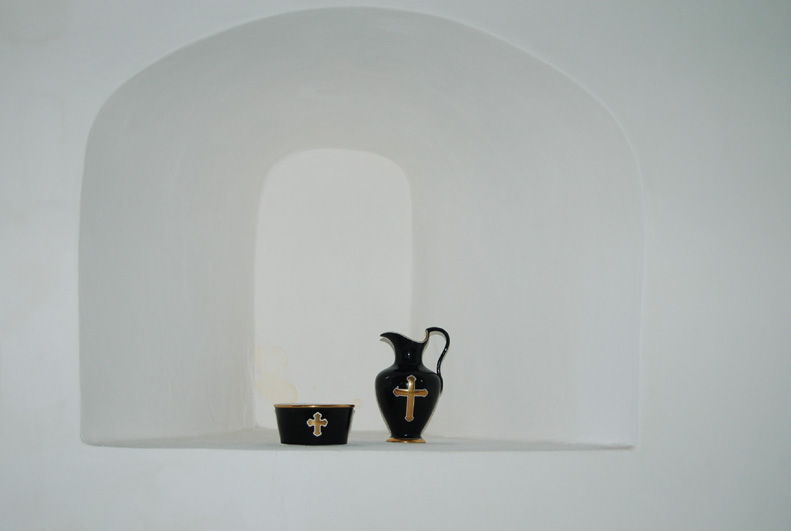
Interior


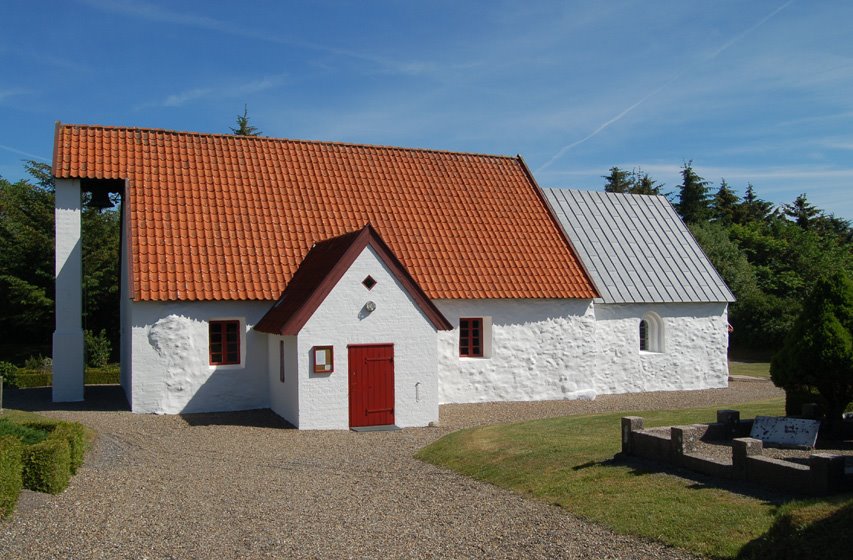
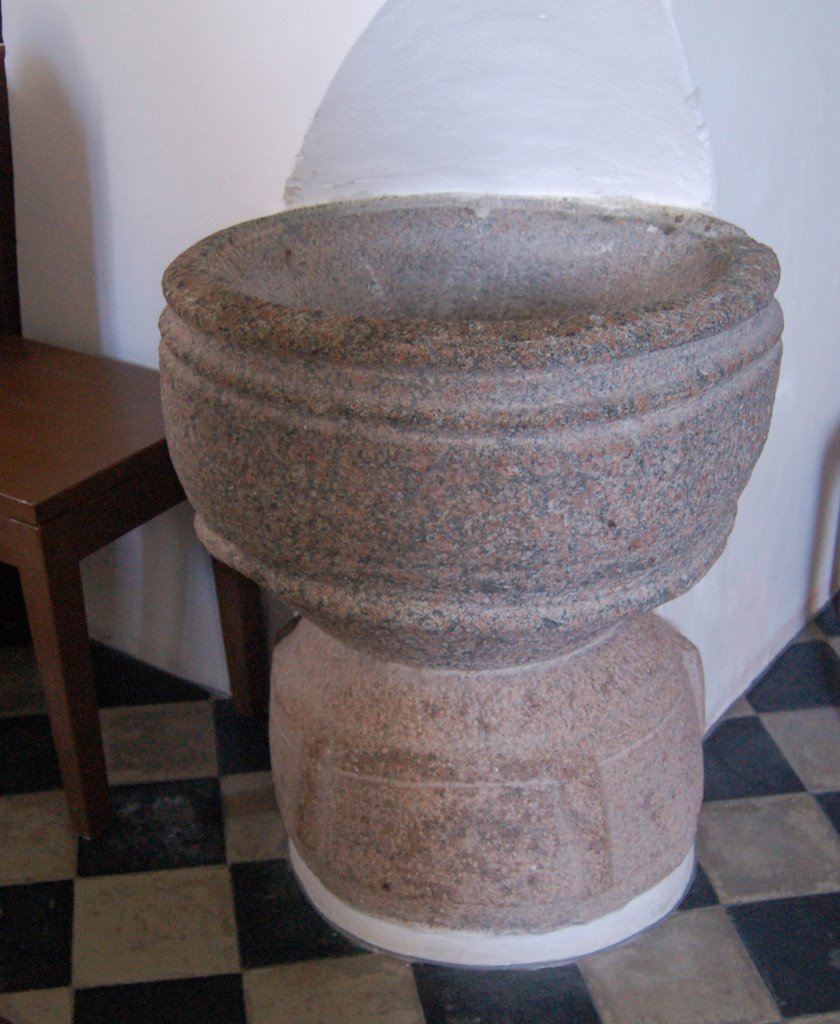
The baptismal font from 1100s.
Simplicity is tranquility


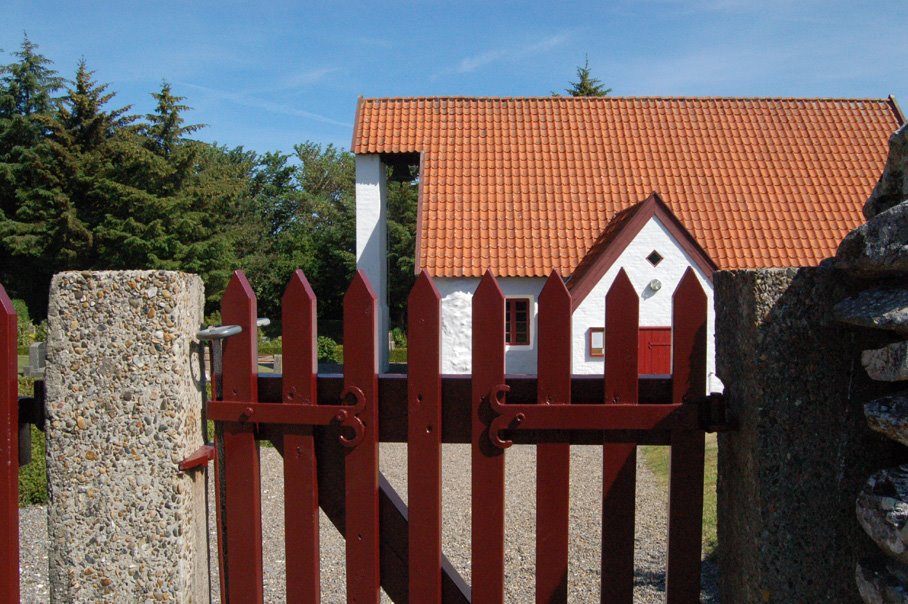
Vigsø Church, the entrance

The small lonely situated Vigsø Church has a choir and nave probably from the Romanesque period in the 1100s, a new porch to the south and a bell-gallow to the west. The original building is like Lild Church built in materials from the surrounding area - limestone, chalk and flint. The straight-edged south door is covered in planks and the north door is only seen as an inside point-arched niche. The inside of the church has beamed ceilings and the choir arch is newly bricked up with small stones like the porch and the bell-gallow. The church was restored in 1930.

The communion table had still in 1875 a monolitplate, but consists now of a plank-box from the same time as the altar piece, a simple, rather strange joinery, symbolizing Heaven's Door. A Romanesque granite font with a profiled basin has the foot partly walled in the choir arch. The pulpit is Renaissance from ab. 1600. The church bell from ab. 1500 is probably cast by Peder Hansen, Flensborg.

Some epitaphs from the 1700s and 1800s. Three grave-trees from the first of the 1800s are now in Thisted Museum and two others from the end of the 1700s are at the National Museum in Copenhagen.

Names in the Middle Ages and 1600s:
Vigsø (1442 Vixø, *1443 Vixe); Bjerre (* 1497 Bierby, 1552 Buierre); Rosholm (1662 Roesholm); Hesseldal ( 1600 Hiszildall, 1688 Hesseldall); Tovsgaard (1551 Tosberig, 1600 Todtzberig, Thoffdsberig, 1664 Thausgaard), Bavn (1663 Baun); Votborg (1664 Wotborig); Søborg (1418 Siøborich); Krægpøt (1666 Kregpyt); Ny and Gl. Overgård (1661 Offuergd).

In 1442-43 the væbner Jens Lauridsen is mentioned. (He had a squirrel in his coat of arms, and it is probably not true that he in several places was included under the family Friis of Vadskærgård, it is more possible that he belonged to the family Friis of Hesselager) Vixøgård is still mentioned in the end of the 1600s.

In the parish was the farm Brunbjerg (1603 Bronbiere, 1672 Brunbiere, 1688 Brundborig, 1778 Brundberg).

The area by Vigsø church shows that the subsurface is marked by chalk and flint. The church yard is piled up by lots and lots of flat flint blocks which probably were fetched from the beach. In 1555 the sand drift had damaged the parish terribly - and the parish priest suggested that Vigsø Church should be demolished. In 1690 there were dunes about 14 m high on the field by the vicarage. But the little simple church still lies there in a rather lonely place not far from the North Sea.

Listed prehistorics: 8 hills, of which one with a flat top on the church yard.
Demolished or destroyed: 18 hills, in one of them was a coffin built in limestone plates, it contained a bronze sword.

Source: Trap Danmark, Thisted amt, 1961.

photo June 2006: grethe bachmann

Monday, May 18, 2009

Hjardemål church /Hjardemål kirke, Hillerslev herred, Thisted amt.


Hjardemål Church , Thy
a few km south of the North Sea by Vigsø Bugt


Interior.


The Romanesque granite font is of Thybo-type.


A back entrance to the church yard.


A lake with water lilies in Hjardemål Dune Plantation.

The church has a Romanesque choir and nave, a Late Gothic western tower and a southern porch from the 1800s. The Romanesque building is in granite ashlars. Both doors are preserved , the south door is in use, the north door stands with an inside niche. The east window of the choir is an inside niche, while the round arched window to the north is well preserved. The nave has kept two original windows. In several places in the walls are ashlars with stone mason marks.
The unusual tall and heavy tower from about 1500 is built in monk bricks above re-used ashlars. The tower was a light house in its earlier days, but since the plantations grew up, it is invisible from the sea.

The church has beamed ceilings. The triumph arch has profiled 'kragsten'. The altar piece is made of three point arched fields with paintings from 1837. Above the altar piece is placed a square sounding board from ab. 1600. A romanesque granite font of thybo-type . A south German baptismal basin from ab. 1575. The pulpit is from ab. 1600. The sounding board above the pulpit is contemporary . The gallery in the western part of the church is from ab. 1600. The church bell from 1513.

Epitaph ab. 1650 on Chr. Nielsen Morsing, + 1673, a joinery in rural Renaissance. Gravestone 1) Lauridtz Jensen Koch, + 1691 and wife, 2) parish priest Peder Nielsen Sengeløs, + 1699.

Names in the Middle Ages and the 1600s:
Hjaremål/Hjardemål (* 1436 Hiarmull, 1477 Hormol, 1505 Hiermall, 1664 Hiarmall);
Kåse (*1435 Kaasse); Tved (1600 Tuedt); Skiverklit (1470 Skyrdklitte, Skywrklitte, 1483 Skørclith); Blovsgaarde (1602 Blagsgaardt, 1664 Blochsgaard); Rimmegaard (1664 Rimergaard, 1688 Paa Remmen); Rovergaard ( 1638 Rovad); Oddersbøl (1600 Odersbøll); Madsbøl (1477 Marssbol); Langhov( 1603 Langschou, 1664 Paa Haw).

Oddersbøl ( in 1686 belonging to Vesløsgaard), was owned after 1686 by Laurids Koch (+1691) and then his widow Anne Sørensdatter Guldager, whose daughter Anne brought it to her husband Casper Preetzmann. In 1752 it belonged to his son Erik Zacharias Preetzmann (+1772), whose widow Margrethe Hesseldahl kept it until her death in 1796.

Esper Hvas of Tved (the family Hvas of Skjortholt) is mentioned in 1568.

In 1477 Per Nielsen of Langvad had estate Marssbol in pawn for 16 mark dansk by Otto Stampe (the family Stampe of Klarupgård) and Ingerd Lauridsdattter (maybe O. Stampe's wife), whose rightful inheritance it was. In 1505 Otto Stampe's son Mogens Stampe sold "Morsbooel" to Margrethe Turesdatter (Bjelke) of Ågård.

In 1472 væbner Michel Terkildsen of Korssze is mentioned.

The house Voldum is the rest of a village by the same name (1508 Vollom) In the parish is in 1552 and later mentioned the farm Medelklit, ab. 1600 the farms Ved Kæret (1600 Vid Kieridt) and Fladskæret (1603 Fladtzkeridt), in 1664 the farms Wed Blød and Lille Odersbøl.

Listed prehistorics:
Two hills of which one at Tved is large. Demolished hills not noted, but two Bronze Age grave findings are known, both with a dagger and a pålstav (axe-type). At Korsø were found several graves, built in limestone, with graves from Roman Iron Age.

The parish - being only a few km from the North Sea - has suffered extremely from sand drift. But the large Hjardemål Dune Plantation is not only sand. There are several small lakes.

Source: Trap Danmark, Thisted amt, 1961

photo 15 June 2006: grethe bachmann